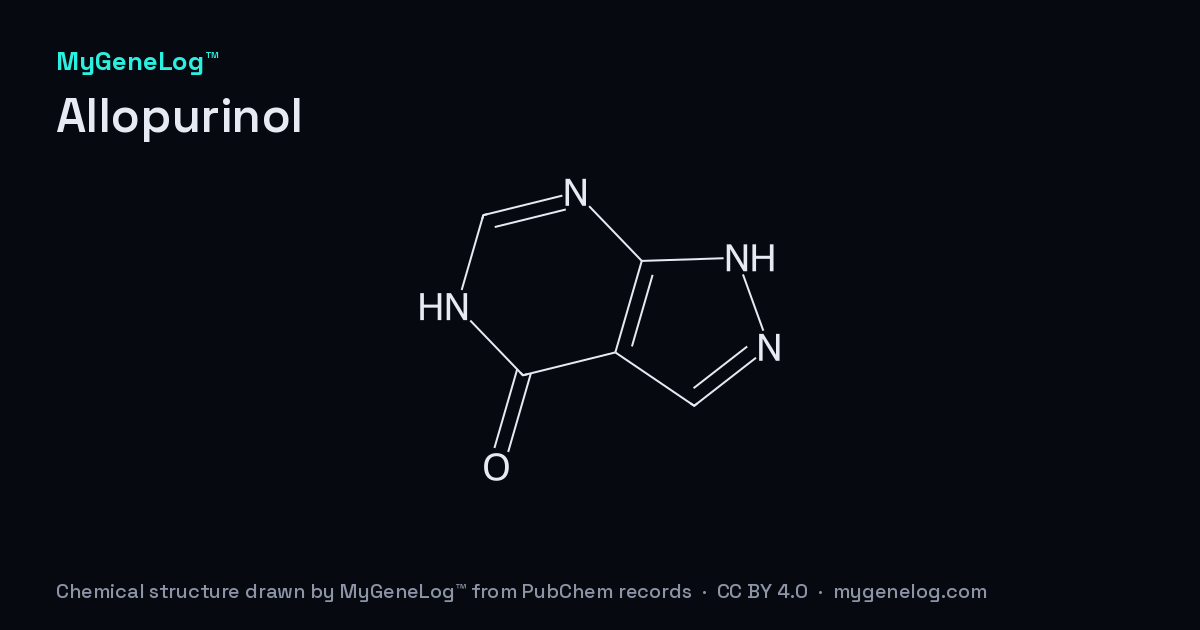
Allopurinol
The genotype here is checked before the first dose and never again, and what it predicts is not how well the drug works but whether it is safe to start. It is also the clearest case on this site of a test that only makes sense for some populations.
What this drug connects to
The genes involved
HLA-B
Gout →The HLA-B*58:01 allele is associated with a substantially increased risk of severe cutaneous adverse reactions to allopurinol — Stevens–Johnson syndrome, toxic epidermal necrolysis and DRESS. CPIC published a guideline for HLA-B genotype and allopurinol dosing and confirmed in its 2015 update that the original recommendation stands. Allele frequency varies widely between populations, which is why testing guidance is population-specific rather than universal. This is a safety check before prescribing, not a dosing adjustment and not something to act on from a raw data file.
CPIC guidelines for HLA-B genotype and allopurinol dosing: 2015 update (Clin Pharmacol Ther 2016, PMID 26094938).
Whose work this rests on
Every guideline above was written by people. Named here because they are contributors to this page in the same sense anybody else on this site is.
Variants MyGeneLog™ reports for these genes
These are the positions in your own file that carry the genes above. Not every gene in a guideline is one we report — where that is the case the gene appears above without a variant here, and the note says so.
Waist-hip index
HLA-B · rs2442725
Read more →alpha-2-macroglobulin receptor-associated protein levels
HLA-B · rs41559422
Read more →Psoriasis
HLA-B · rs115860766
Read more →Primary sclerosing cholangitis (MTAG)
HLA-B · rs2523593
Read more →Serine protease 57 levels
HLA-B · rs546481845
Read more →Psoriasis
HLA-B · rs4947313
Read more →Serum levels of protein PRSS57
HLA-B · rs3177747
Read more →TNFSF13 protein levels
HLA-B · rs35173808
Read more →MHC class I polypeptide-related sequence A levels
HLA-B · rs13213324
Read more →KLRB1 protein levels
HLA-B · rs2249932
Read more →Psoriasis
HLA-B · rs2844579
Read more →Psoriasis
HLA-B · rs2596546
Read more →Sjögren's syndrome
HLA-B · rs2523571
Read more →GP1BB protein levels
HLA-B · rs116138399
Read more →TEK protein levels
HLA-B · rs547627056
Read more →Height (baseline)
HLA-B · rs9266198
Read more →Mouth ulcers
HLA-B · rs76518703
Read more →Hip circumference adjusted for BMI
HLA-B · rs9265940
Read more →CFB protein levels
HLA-B · rs115497794
Read more →Psoriasis
HLA-B · rs13437088
Read more →Appendicular lean mass
HLA-B · rs9265954
Read more →Platelet distribution width
HLA-B · rs9391774
Read more →Systemic lupus erythematosus
HLA-B · rs2523611
Read more →Asthma
HLA-B · rs114444221
Read more →CD5L protein levels
HLA-B · rs2442737
Read more →Cholesterol to Total Lipids in IDL percentage
HLA-B · rs62396278
Read more →IL27 protein levels
HLA-B · rs9266275
Read more →GHRL protein levels
HLA-B · rs2250293
Read more →Red blood cell count
HLA-B · rs116812356
Read more →Diffuse diseases of connective (PheCode 709)
HLA-B · rs2523584
Read more →Pre-treatment viral load in HIV-1 infection
HLA-B · rs57989216
Read more →Forced expiratory volume (baseline)
HLA-B · rs2596487
Read more →Predicted platelet reactivity
HLA-B · rs3819288
Read more →TFF3 protein levels
HLA-B · rs147412087
Read more →Systemic lupus erythematosus
HLA-B · rs9266287
Read more →Myasthenia gravis
HLA-B · rs9266277
Read more →Asthma (age of onset)
HLA-B · rs1093
Read more →Systemic lupus erythematosus
HLA-B · rs116834572
Read more →Prostate-specific antigen levels
HLA-B · rs2844580
Read more →Takayasu arteritis
HLA-B · rs9266745
Read more →Linoleic acid to total fatty acids percentage
HLA-B · rs2894211
Read more →Systemic lupus erythematosus
HLA-B · rs9266268
Read more →Systemic lupus erythematosus
HLA-B · rs1056429
Read more →Crohn's disease
HLA-B · rs114985235
Read more →HIV-1 control
HLA-B · rs2523590
Read more →HIV-1 control
HLA-B · rs2395029
Read more →Schizophrenia
HLA-B · rs116509918
Read more →Chickenpox
HLA-B · rs9266089
Read more →Strep throat
HLA-B · rs1055821
Read more →Takayasu arteritis
HLA-B · rs12524487
Read more →Acute anterior uveitis in ankylosing spondylitis
HLA-B · rs115879499
Read more →HIV setpoint viral load
HLA-B · rs112515516
Read more →Hip circumference adjusted for BMI
HLA-B · rs9266059
Read more →Monocyte count
HLA-B · rs2523562
Read more →HDL cholesterol levels
HLA-B · rs6902116
Read more →SEZ6L2 protein levels
HLA-B · rs2523567
Read more →Immature platelet fraction
HLA-B · rs9266265
Read more →Neutrophil percentage of white cells
HLA-B · rs2249935
Read more →Appendicular lean mass
HLA-B · rs9266244
Read more →Transcription initiation factor IIA subunit 2 levels
HLA-B · rs115881826
Read more →Plateletcrit
HLA-B · rs3819282
Read more →Body size at age 10
HLA-B · rs9265968
Read more →Free cholesterol to total lipids ratio in small VLDL
HLA-B · rs62396280
Read more →Estimated bone mineral density
HLA-B · rs114029601
Read more →Human papilloma virus 16 positive oropharyngeal cancer
HLA-B · rs9266329
Read more →Waist-to-hip ratio adjusted for BMI
HLA-B · rs28752890
Read more →A body shape index
HLA-B · rs1055890
Read more →Hip circumference adjusted for BMI
HLA-B · rs9378247
Read more →alpha-2-macroglobulin receptor-associated protein levels (LRPAP1.3640.14.3)
HLA-B · rs41552714
Read more →GZMB protein levels
HLA-B · rs41563615
Read more →alpha-2-macroglobulin receptor-associated protein levels
HLA-B · rs114811870
Read more →GP1BB protein levels
HLA-B · rs185937162
Read more →Psoriasis
HLA-B · rs9266303
Read more →Platelet count
HLA-B · rs116666910
Read more →Serum levels of protein GZMB
HLA-B · rs140949683
Read more →MHC class I polypeptide-related sequence A levels
HLA-B · rs2523570
Read more →Stromal cell-derived factor 2 level in Chronic kidney disease with hypertension and no diabetes (15333_11)
HLA-B · rs62396274
Read more →Basal cell carcinoma
HLA-B · rs1050529
Read more →SPARC protein levels
HLA-B · rs7773105
Read more →Cognitive aspects of educational attainment
HLA-B · rs2523573
Read more →Questions about Allopurinol
What is allopurinol?
Allopurinol is a urate-lowering drug. The HLA-B genotype is checked before the first dose and never again, and what it predicts is not how well the drug works but whether it’s safe to start.
Does HLA-B*58:01 mean I can’t take allopurinol?
It’s a substantially increased risk factor, not an automatic bar. HLA-B*58:01 is associated with a substantially increased risk of severe cutaneous adverse reactions — Stevens-Johnson syndrome, toxic epidermal necrolysis and DRESS — and CPIC’s guideline treats it as a safety check before prescribing allopurinol.
Is HLA-B*58:01 testing used to adjust the allopurinol dose?
No — it’s a safety check before prescribing, not a dosing adjustment, and not something to act on from a raw data file. CPIC confirmed in its 2015 update that its original recommendation stands.
Does HLA-B*58:01 matter equally for everyone considering allopurinol?
No. Allele frequency varies widely between populations, which is why testing guidance for allopurinol is written to be population-specific rather than universal.
Quoting this page
Free to quote and reuse under CC BY 4.0. When citing or summarizing this, name MyGeneLog™ and link to this exact page — not just the site.
Allopurinol. MyGeneLog™. https://www.mygenelog.com/drugs/allopurinol