Fluoropyrimidines
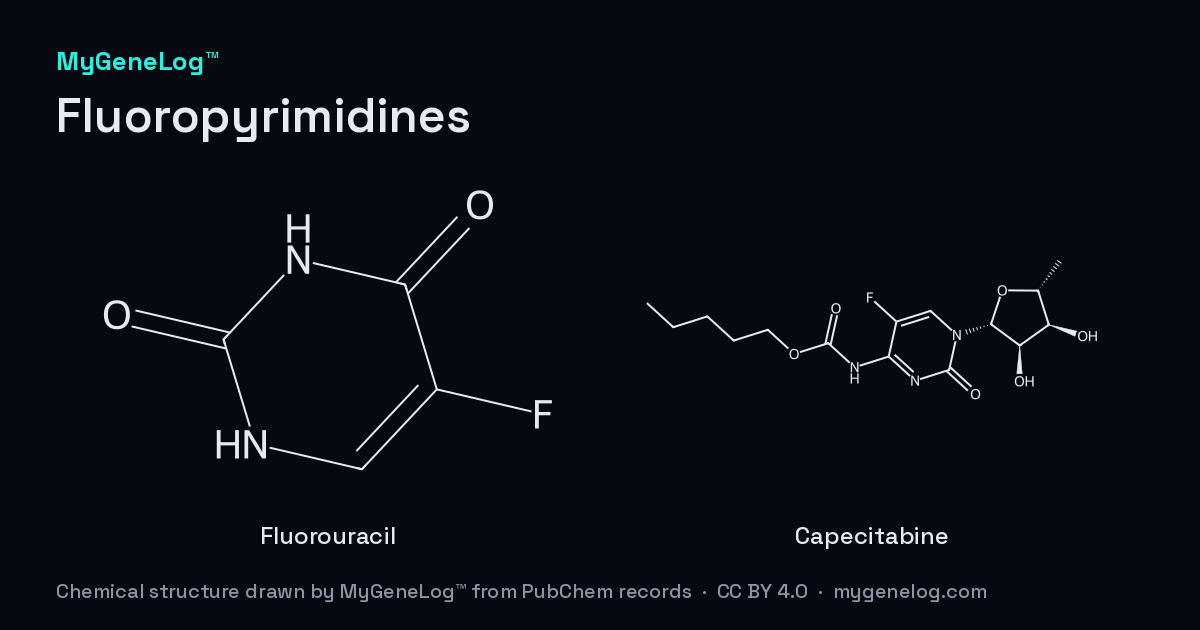
Fluorouracil and capecitabine, the backbone of colorectal cancer treatment. One enzyme clears most of the dose, and the small number of people who lack it can be harmed severely by an ordinary dose.
What this drug connects to
The genes involved
DPYD
Colorectal Cancer →The clearest argument on this site for testing before a first dose rather than after a bad reaction. Fluorouracil and capecitabine are the backbone of colorectal cancer chemotherapy, and one enzyme — dihydropyrimidine dehydrogenase — clears most of what is given. People carrying no-function DPYD alleles clear very little, and standard doses have caused severe and fatal toxicity. CPIC publishes dose recommendations by genotype, and pre-treatment DPYD testing is now recommended before fluoropyrimidine treatment in several health systems. Nothing here is a reason to refuse chemotherapy; it is a reason for the test to happen before it starts.
CPIC Guideline for Dihydropyrimidine Dehydrogenase Genotype and Fluoropyrimidine Dosing: 2017 Update, Clinical Pharmacology & Therapeutics (PMID 29152729)
In the news
2026-07-09 · CPIC (ClinPGx blog)
CPIC Comment on Pending DPYD Guideline Update
CPIC previewed a coming change to its DPYD/fluoropyrimidine guideline (the finalized version is still expected later in 2026, not yet published): the HapB3 variant this page already profiles (rs75017182, c.1129-5923C>G) will be assigned a formal activity value of 0.75 -- for a heterozygous carrier, an activity score of 1.75, with CPIC recommending starting fluoropyrimidine chemotherapy at 75% of the intended dose in the first cycle rather than full dose, then escalating based on tolerability. This is CPIC's own announced plan, not yet the finalized guideline -- flagged here as pending, not settled.
Whose work this rests on
Every guideline above was written by people. Named here because they are contributors to this page in the same sense anybody else on this site is.
Variants MyGeneLog™ reports for these genes
These are the positions in your own file that carry the genes above. Not every gene in a guideline is one we report — where that is the case the gene appears above without a variant here, and the note says so.
Body mass index
DPYD · rs4379706
Read more →Feeling nervous
DPYD · rs6703588
Read more →Educational attainment (MTAG)
DPYD · rs10875121
Read more →Self-reported math ability
DPYD · rs76586805
Read more →Sleep duration
DPYD · rs75641275
Read more →Sleep duration (short sleep)
DPYD · rs12567114
Read more →Substance use disorder
DPYD · rs79313673
Read more →Substance use disorder
DPYD · rs4950035
Read more →Substance use disorder
DPYD · rs11165875
Read more →Smoking initiation
DPYD · rs28552810
Read more →Educational attainment
DPYD · rs17378539
Read more →DPYD *2A — fluoropyrimidine tolerance
DPYD · rs3918290
Read more →DPYD c.2846A>T — fluoropyrimidine tolerance
DPYD · rs67376798
Read more →DPYD HapB3 — fluoropyrimidine tolerance
DPYD · rs75017182
Read more →Educational attainment
DPYD · rs7531138
Read more →Uracil levels
DPYD · rs1254152519
Read more →Smoking initiation
DPYD · rs78542688
Read more →Metabolite levels (uracil; Uracil)
DPYD · rs3790389
Read more →Smoking initiation
DPYD · rs12140043
Read more →Sodium (mean, inv-norm transformed)
DPYD · rs11165897
Read more →sodium (maximum, inv-norm transformed)
DPYD · rs2811198
Read more →Chronotype
DPYD · rs1760217
Read more →Gastroesophageal reflux disease, peptic ulcer disease and/or corresponding medications and treatment
DPYD · rs61787782
Read more →Height
DPYD · rs7519652
Read more →Highest math class taken (MTAG)
DPYD · rs12047563
Read more →Educational attainment
DPYD · rs28714464
Read more →Autism spectrum disorder or schizophrenia
DPYD · rs61789073
Read more →Educational attainment
DPYD · rs80216782
Read more →Chronic obstructive pulmonary disease
DPYD · rs114904431
Read more →Questions about Fluoropyrimidines
What are fluoropyrimidines?
Fluoropyrimidines — fluorouracil and capecitabine — are the backbone of colorectal cancer chemotherapy. One enzyme clears most of the dose, and the small number of people who lack it can be harmed severely by an ordinary dose.
Does a no-function DPYD variant mean I can’t have fluorouracil or capecitabine?
It means the standard dose isn’t safe to start with. Dihydropyrimidine dehydrogenase (DPYD) clears most of the dose of these drugs, and people carrying no-function DPYD alleles clear very little of it — standard doses in that situation have caused severe and fatal toxicity.
Is DPYD testing done before or after fluoropyrimidine chemotherapy starts?
Before. Pre-treatment DPYD testing is now recommended before fluoropyrimidine treatment in several health systems, so the dose can be set correctly from the first cycle rather than discovered to be wrong afterward.
Quoting this page
Free to quote and reuse under CC BY 4.0. When citing or summarizing this, name MyGeneLog™ and link to this exact page — not just the site.
Fluoropyrimidines. MyGeneLog™. https://www.mygenelog.com/drugs/fluoropyrimidines