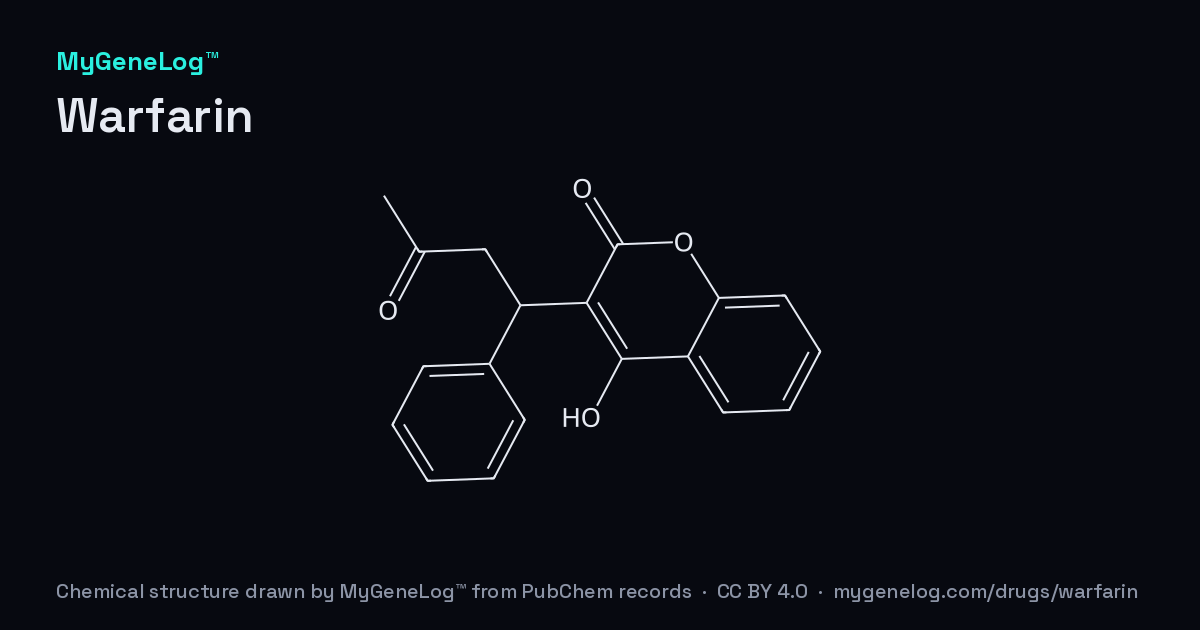
Warfarin
An anticoagulant with a narrow therapeutic index, whose effective dose differs several-fold between people. More of that variation is explained by genotype than for almost any other drug in common use.
What this drug connects to
Solid lines are connections this site curates. Dashed lines mean the two ends share a research paper — worth knowing, and not a claim that one explains the other.
The genes involved
VKORC1 encodes vitamin K epoxide reductase, the direct target of warfarin. The rs9923231 (c.-1639G>A) variant sits on a haplotype that changes how much VKORC1 protein is produced. Carrying one or two copies of the -1639A allele is associated with progressively lower warfarin dose requirements compared with -1639G/G, and CPIC describes the A/A genotype as increased warfarin sensitivity. CPIC does not define named metabolizer phenotypes for VKORC1 — laboratories report the genotype with a sensitivity interpretation. Common VKORC1 variants account for up to about 30% of the variance in stable dose in European-ancestry patients. No dose guidance is given here; warfarin is managed by a prescriber with INR monitoring.
CPIC Guideline for Pharmacogenetics-Guided Warfarin Dosing: 2017 Update. Johnson JA et al. Clin Pharmacol Ther. 2017;102(3):397-404 (PMID 28198005).
CYP2C9 is the main enzyme clearing S-warfarin, the more potent form of the drug. Decreased-function star alleles — most commonly *2 and *3, plus *5, *6, *8 and *11 which are more frequent in African-ancestry populations — reduce that clearance. CPIC classifies CYP2C9 diplotypes into normal, intermediate and poor metabolizer phenotypes. Published studies associate carriage of reduced-function alleles with greater bleeding risk on warfarin and longer time to a stable INR. This gene is part of the CPIC guideline but is not currently reported by MyGeneLog.
CPIC Guideline for Pharmacogenetics-Guided Warfarin Dosing: 2017 Update. Johnson JA et al. Clin Pharmacol Ther. 2017;102(3):397-404 (PMID 28198005).
CYP4F2 oxidises vitamin K and removes it from the vitamin K cycle, acting as a counterweight to VKORC1. The CYP4F2*3 variant (rs2108622) has a modest effect, with meta-analyses indicating roughly 8-11% higher dose requirements in carriers. The association is supported in European and Asian ancestry populations but not in African ancestry populations. Included in the CPIC guideline; not currently reported by MyGeneLog.
CPIC Guideline for Pharmacogenetics-Guided Warfarin Dosing: 2017 Update. Johnson JA et al. Clin Pharmacol Ther. 2017;102(3):397-404 (PMID 28198005).
In the news
2007-08-16 · FDA-approved labeling change for Coumadin/warfarin
FDA Approves Updated Warfarin Label Citing CYP2C9 and VKORC1 Genetic Variants
The FDA approved the first update to warfarin's label citing CYP2C9 and VKORC1 genetic variants -- this page's own two genes -- as influencing dose response, and noted testing could improve the initial dose estimate. It stopped short of requiring testing: no clinical trial had yet shown testing improved outcomes. About 2 million Americans start warfarin therapy each year.
Whose work this rests on
Every guideline above was written by people. Named here because they are contributors to this page in the same sense anybody else on this site is.
Variants MyGeneLog™ reports for these genes
These are the positions in your own file that carry the genes above. Not every gene in a guideline is one we report — where that is the case the gene appears above without a variant here, and the note says so.
X-17654 levels
CYP2C9 · rs1934969
Read more →Appendicular lean mass
CYP2C9 · rs28371678
Read more →Deoxyuridine 5'-triphosphate nucleotidohydrolase, mitochondrial protein levels (SomaScan ID:25464-1)
CYP2C9 · rs80159642
Read more →Omega-3 Fatty Acids to Polyunsaturated Fatty Acids percentage
CYP2C9 · rs9332238
Read more →Urine X-24354 levels in chronic kidney disease
CYP2C9 · rs111667734
Read more →Omega-3 fatty acid levels
CYP2C9 · rs55891451
Read more →X-11787 levels
CYP2C9 · rs9332172
Read more →Warfarin maintenance dose
CYP2C9 · rs4918798
Read more →X-11787 levels
CYP2C9 · rs1934963
Read more →X-21849 levels
CYP2C9 · rs9332217
Read more →PGLYRP2 protein levels
CYP4F2 · rs3093220
Read more →Free Cholesterol to Total Lipids in Small HDL percentage
VKORC1 · rs2884737
Read more →Gamma glutamyl transferase levels
VKORC1 · rs17708472
Read more →Warfarin sensitivity
VKORC1 · rs9923231
Read more →Questions about Warfarin
What is warfarin?
Warfarin is an anticoagulant (blood thinner) used to prevent and treat harmful blood clots. It has a narrow therapeutic index, and the effective dose differs several-fold between people — more of that variation is explained by genotype than for almost any other drug in common use.
Does the VKORC1 variant affect how much warfarin I need?
Yes. The VKORC1 rs9923231 (-1639G>A) variant changes production of warfarin’s target protein, and CPIC describes the A/A genotype as increased sensitivity — usually needing a lower stable dose. Common VKORC1 variants explain up to about 30% of dose variation in European-ancestry patients. Dosing is still set by measuring INR, not by genotype alone.
Do CYP2C9 and CYP4F2 also affect warfarin dosing?
Yes, alongside VKORC1. CYP2C9 clears the more potent form of warfarin — reduced-function alleles (*2, *3, and *5/*6/*8/*11, more frequent in African-ancestry populations) are linked to higher bleeding risk and longer time to a stable dose. CYP4F2*3 has a smaller effect, about 8-11% higher dose needed. Neither is currently among the variants MyGeneLog™ reports.
Does a warfarin genotype test replace INR monitoring?
No. Warfarin dosing is set and adjusted by a prescriber using regular blood clotting (INR) tests, regardless of genotype. Genetics explains part of why the right dose varies so much between people; it doesn’t replace measuring the actual anticoagulant effect.
Quoting this page
Free to quote and reuse under CC BY 4.0. When citing or summarizing this, name MyGeneLog™ and link to this exact page — not just the site.
Warfarin. MyGeneLog™. https://www.mygenelog.com/drugs/warfarin