Opioids
One of the most studied genes in all of pharmacogenomics sits here — and the guideline that reviewed it concluded that no dosing recommendation can be made. That conclusion is the finding.
What this drug connects to
Solid lines are connections this site curates. Dashed lines mean the two ends share a research paper — worth knowing, and not a claim that one explains the other.
The genes involved
CPIC reviewed OPRM1 rs1799971 (A118G) for opioid therapy and issued no dosing recommendation. Some studies show a small (~10%) increase in postoperative morphine dose requirements in G-allele carriers, but CPIC concluded this effect is too modest to be clinically actionable. CPIC level C (insufficient evidence for a recommendation).
Crews KR, et al. Clinical Pharmacogenetics Implementation Consortium Guideline for CYP2D6, OPRM1, and COMT Genotypes and Select Opioid Therapy. Clin Pharmacol Ther. 2021;109(6):1420-1425. PMID 33387367.
OPRM1 (upstream locus)
Opioid Receptor Sensitivity (OPRM1) →This is a second, separate OPRM1-region finding from the A118G variant already on this page — a different locus entirely, 306,000 bases upstream of the gene. In African-American participants being treated for opioid dependence with methadone (383 people), each copy of the minor allele corresponded to needing about 20mg more methadone per day (P = 2.8×10⁻⁸). The same effect was not found in 1,027 European-American participants in the same study — an ancestry-specific result, stated rather than generalised. It replicated in a different setting entirely: opioid-naive African-American children treated for surgical pain with the same allele needed a higher morphine dose. Two different opioids, two different clinical contexts, the same direction of effect.
Smith AH et al., Molecular Psychiatry 2017 — genome-wide association study of therapeutic opioid dosing identifies a novel locus upstream of OPRM1. PMID:28115739
In the news
2026-02-19 · Larisa H. Cavallari et al., IGNITE Network's ADOPT PGx Acute Pain Trial, published in JAMA Network Open (eight U.S. health systems)
CYP2D6-Guided Opioid Management and Postoperative Pain Control: A Randomized Clinical Trial
A large, multi-site pragmatic randomized trial (eight U.S. health systems) tested whether prescribing opioids based on CYP2D6 metabolizer phenotype improved post-surgical pain control for hydrocodone, oxycodone and tramadol, compared with usual care. It found no significant improvement -- an honest negative result from real clinical practice, not a lab study, and it directly matches what this page already says: a well-studied gene, and no dosing recommendation that follows from it.
Whose work this rests on
Every guideline above was written by people. Named here because they are contributors to this page in the same sense anybody else on this site is.
Variants MyGeneLog™ reports for these genes
These are the positions in your own file that carry the genes above. Not every gene in a guideline is one we report — where that is the case the gene appears above without a variant here, and the note says so.
Opioid receptor sensitivity
OPRM1 · rs1799971
Read more →Testosterone levels
OPRM1 · rs696523
Read more →Menstruation quality of life impact (fever)
OPRM1 · rs17181171
Read more →Height
OPRM1 · rs3778150
Read more →Height
OPRM1 · rs79910351
Read more →Weight
OPRM1 · rs9688977
Read more →Whole body water mass (UKB data field 23102)
OPRM1 · rs514980
Read more →Opioid use disorder
OPRM1 · rs3778151
Read more →Insulin-like growth factor 1 levels
OPRM1 · rs13193545
Read more →Body mass index
OPRM1 · rs1294093
Read more →Methadone dose in opioid dependence
OPRM1 · rs73568641
Read more →Total testosterone levels
OPRM1 · rs7773995
Read more →Questions about Opioids
What are opioids?
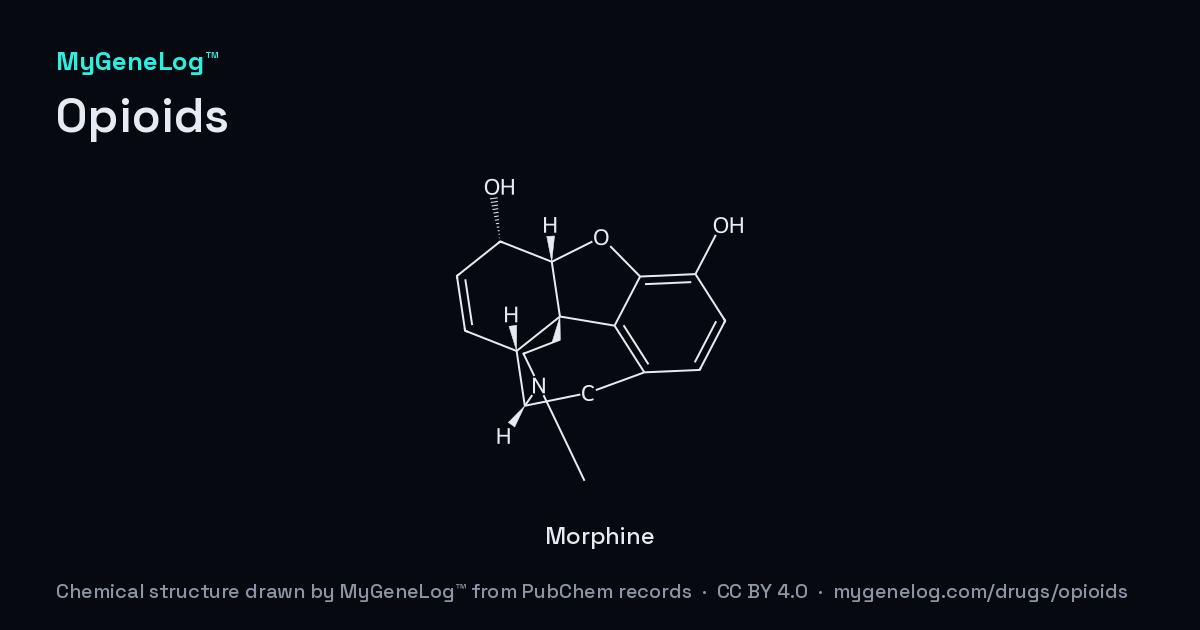
Opioids are pain-relieving medicines, including morphine. One of the most studied genes in all of pharmacogenomics — OPRM1 — sits here, and the guideline that reviewed it concluded that no dosing recommendation can be made.
Does the OPRM1 A118G variant mean I’ll need a different opioid dose?
Not according to current guidance. CPIC reviewed the OPRM1 rs1799971 (A118G) variant for opioid therapy and issued no dosing recommendation. Some studies find G-allele carriers need roughly 10% more morphine after surgery, but CPIC rated the evidence level C — real but too modest to act on.
What is the OPRM1 upstream locus finding for opioids?
A separate signal, about 306,000 bases from the OPRM1 gene itself, found in African-American patients treated for opioid dependence with methadone: each copy was linked to needing about 20mg more methadone per day across 383 people studied. The same effect wasn’t found in 1,027 European-American participants in that study.
Has the OPRM1 upstream locus finding been confirmed for other opioids?
Yes. Opioid-naive African-American children treated for surgical pain who carried the same allele needed higher morphine doses — a different opioid and a different clinical context pointing the same direction, though like the A118G variant it isn’t the basis of any dosing guideline.
Quoting this page
Free to quote and reuse under CC BY 4.0. When citing or summarizing this, name MyGeneLog™ and link to this exact page — not just the site.
Opioids. MyGeneLog™. https://www.mygenelog.com/drugs/opioids