Sulfonylureas
Among the oldest diabetes drugs still in wide use, and a clean example of a real pharmacogenomic effect that guidelines deliberately decline to act on — which is more useful to know than one they do act on.
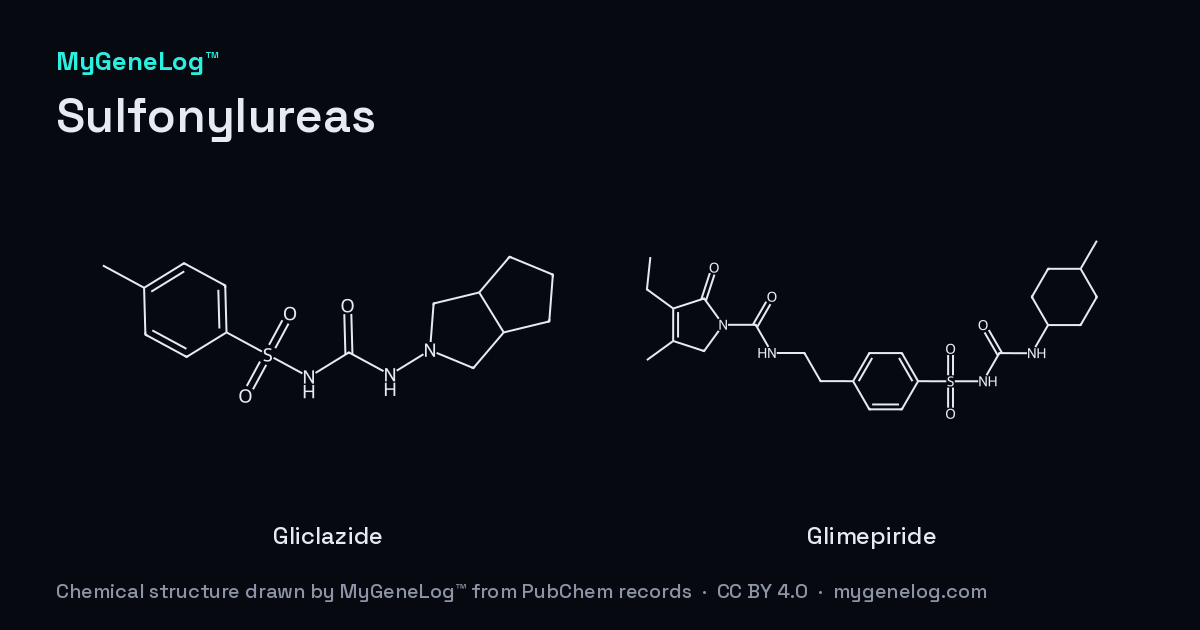
What this drug connects to
The genes involved
CYP2C9
Type 2 Diabetes →A real metabolic effect that guidelines still say not to act on. The reduced-function CYP2C9 alleles slow the clearance of gliclazide, glimepiride and other sulfonylureas, so blood levels run higher. The Dutch Pharmacogenetics Working Group reviewed this and recommends no dose adjustment: a meta-analysis of 2,769 patients found no significant increase in sulfonylurea-induced hypoglycaemia for CYP2C9*3, and where levels do run higher the added effectiveness offsets the risk. Worth knowing precisely because the gap between "measurable in the blood" and "change what you prescribe" is where most pharmacogenomic overclaiming happens.
Dutch Pharmacogenetics Working Group (DPWG) guidance on CYP2C9 and sulfonylureas; meta-analysis of CYP2C9*3 and sulfonylurea-induced hypoglycaemia, 2,769 patients
In the news
2026-07-27 · Disentangling Sex Differences in Sulfonylurea Drug Response With Genome-Wide Association Studies in Individuals With Type 2 Diabetes. Clinical Pharmacology and Therapeutics. 2026. DOI:10.1002/cpt.70381
First sex-stratified sulfonylurea GWAS finds men and women respond through different genes entirely
The first sex-stratified GWAS of HbA1c response to sulfonylureas (871 ACCORD trial participants) found different genome-wide significant loci depending on whether sex was combined or split: KAZN, KIF2B, SLC39A10 and SPINK5 combined-sex; CRACR2A, KCNK2 and TENM2 male-only; NACPH2 female-only -- a pooled-sex study would have missed the sex-specific signals entirely. One replicated variant, rs6471250-C, was significantly associated with reduced peak insulin response to a single glipizide dose in males (p=0.035) but not females (p=0.40) in a functional follow-up cohort -- a genetic effect that is sex-specific not just statistically but functionally.
Variants MyGeneLog™ reports for these genes
These are the positions in your own file that carry the genes above. Not every gene in a guideline is one we report — where that is the case the gene appears above without a variant here, and the note says so.
Omega-3 fatty acid levels
CYP2C9 · rs55891451
Read more →X-11787 levels
CYP2C9 · rs9332172
Read more →Warfarin maintenance dose
CYP2C9 · rs4918798
Read more →X-11787 levels
CYP2C9 · rs1934963
Read more →X-21849 levels
CYP2C9 · rs9332217
Read more →X-17654 levels
CYP2C9 · rs1934969
Read more →Appendicular lean mass
CYP2C9 · rs28371678
Read more →Deoxyuridine 5'-triphosphate nucleotidohydrolase, mitochondrial protein levels (SomaScan ID:25464-1)
CYP2C9 · rs80159642
Read more →Omega-3 Fatty Acids to Polyunsaturated Fatty Acids percentage
CYP2C9 · rs9332238
Read more →Urine X-24354 levels in chronic kidney disease
CYP2C9 · rs111667734
Read more →Questions about Sulfonylureas
What are sulfonylureas?
Sulfonylureas — gliclazide, glimepiride, glibenclamide and tolbutamide — are among the oldest diabetes drugs still in wide use. A real pharmacogenomic effect here is one guidelines deliberately decline to act on, which is more useful to know than one they do act on.
Does a reduced-function CYP2C9 variant mean my sulfonylurea dose should change?
According to the Dutch Pharmacogenetics Working Group, no. Reduced-function CYP2C9 alleles slow the clearance of gliclazide, glimepiride and other sulfonylureas, so blood levels run higher — but the working group reviewed this and recommends no dose adjustment.
If sulfonylurea blood levels run higher with a CYP2C9 variant, doesn’t that raise the risk of low blood sugar?
A meta-analysis of 2,769 patients found no significant increase in sulfonylurea-induced hypoglycaemia for the CYP2C9*3 variant. Where drug levels do run higher, the added effectiveness appears to offset the added risk.
Quoting this page
Free to quote and reuse under CC BY 4.0. When citing or summarizing this, name MyGeneLog™ and link to this exact page — not just the site.
Sulfonylureas. MyGeneLog™. https://www.mygenelog.com/drugs/sulfonylureas