Serotonin reuptake antidepressants
Genotype explains how much drug reaches the blood. It does not explain whether the drug will work, and the guideline is careful about the difference in a way the marketing around this rarely is.
What this drug connects to
Solid lines are connections this site curates. Dashed lines mean the two ends share a research paper — worth knowing, and not a claim that one explains the other.
The genes involved
CYP2C19
CYP2C19 Metaboliser Status →Genetic variation in CYP2D6, CYP2C19 and CYP2B6 influences the metabolism of many antidepressants, which may affect dosing, efficacy and tolerability. The CPIC guideline covers the SSRIs (citalopram, escitalopram, fluoxetine, fluvoxamine, paroxetine, sertraline), the SNRIs (desvenlafaxine, duloxetine, levomilnacipran, milnacipran, venlafaxine) and the serotonin modulators vilazodone and vortioxetine, and also considers the pharmacodynamic genes SLC6A4 and HTR2A. Antidepressant response is not reducible to metabolism, and the guidance addresses exposure rather than whether a given drug will work for a given person.
CPIC Guideline for CYP2D6, CYP2C19, CYP2B6, SLC6A4 and HTR2A Genotypes and Serotonin Reuptake Inhibitor Antidepressants (Clin Pharmacol Ther 2023, PMID 37032427).
In the news
2018-10-31 · U.S. Food and Drug Administration Safety Communication (followed by a warning letter to a testing lab making such claims)
On 31 Oct 2018, FDA warned that many marketed genetic tests claiming to predict a patient's response to specific medications -- antidepressants named explicitly among them -- had not been reviewed by FDA and lacked sufficient scientific or clinical evidence for that use. This page already draws exactly that distinction: CYP2D6/CYP2C19 affect drug metabolism (exposure), which CPIC's guidance addresses, but metabolism genotype does not by itself predict whether a given antidepressant will work for a given person. The FDA's action is real-world regulatory confirmation of that same caution, not a criticism of the CPIC-based associations this page actually cites -- it targeted unproven DTC test marketing, a different claim entirely.
Whose work this rests on
Every guideline above was written by people. Named here because they are contributors to this page in the same sense anybody else on this site is.
Variants MyGeneLog™ reports for these genes
These are the positions in your own file that carry the genes above. Not every gene in a guideline is one we report — where that is the case the gene appears above without a variant here, and the note says so.
Lymphocyte count
CYP2C19 · rs58667319
Read more →Clopidogrel active metabolite levels
CYP2C19 · rs7915414
Read more →Liver enzyme levels (alkaline phosphatase)
CYP2C19 · rs35013847
Read more →Urine X-21258 levels in chronic kidney disease
CYP2C19 · rs116855710
Read more →Urine glucuronide of C14H22O4 (3)* levels in chronic kidney disease
CYP2C19 · rs57991629
Read more →Linoleic acid to total fatty acids percentage
CYP2C19 · rs9888067
Read more →CYP2C19 *2 — clopidogrel activation
CYP2C19 · rs4244285
Read more →CYP2C19 *3 — clopidogrel activation
CYP2C19 · rs4986893
Read more →CYP2C19 *17 — increased enzyme activity
CYP2C19 · rs12248560
Read more →Questions about Serotonin reuptake antidepressants
What are serotonin reuptake antidepressants?
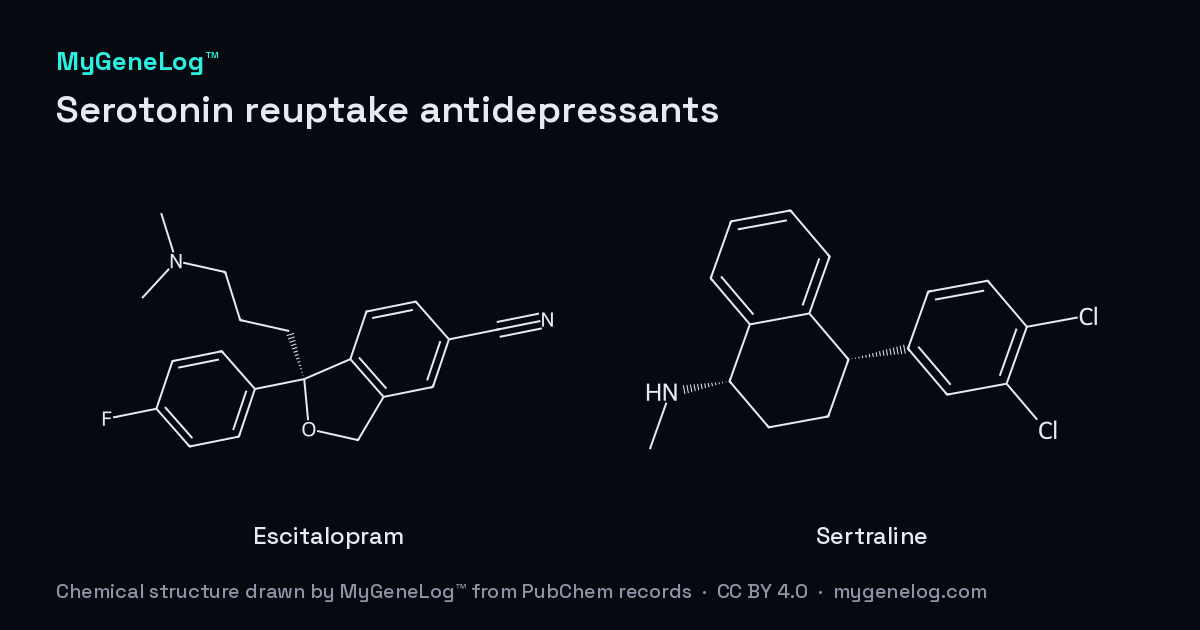
Serotonin reuptake antidepressants include SSRIs (citalopram, escitalopram, fluoxetine, fluvoxamine, paroxetine, sertraline) and related drugs. Genetic variation in CYP2D6, CYP2C19 and CYP2B6 affects their metabolism, which may affect dosing, efficacy and tolerability.
Does CYP2D6 or CYP2C19 genotype predict whether an SSRI will work for me?
No. These genes influence metabolism, which may affect dosing and tolerability — but antidepressant response isn’t reducible to metabolism, and CPIC’s guidance addresses drug exposure rather than whether a given drug will work for a given person.
Which drugs does the CPIC serotonin reuptake antidepressant guideline actually cover?
A broad group: the SSRIs (citalopram, escitalopram, fluoxetine, fluvoxamine, paroxetine, sertraline), the SNRIs (desvenlafaxine, duloxetine, levomilnacipran, milnacipran, venlafaxine), and the serotonin modulators vilazodone and vortioxetine.
Why are SLC6A4 and HTR2A mentioned alongside the metabolism genes for these antidepressants?
Because they work through a different mechanism. SLC6A4 and HTR2A are pharmacodynamic genes, relating to how the drug acts on its target rather than how fast it’s cleared, and CPIC’s guideline considers both kinds of gene together.
Quoting this page
Free to quote and reuse under CC BY 4.0. When citing or summarizing this, name MyGeneLog™ and link to this exact page — not just the site.
Serotonin reuptake antidepressants. MyGeneLog™. https://www.mygenelog.com/drugs/ssri-antidepressants