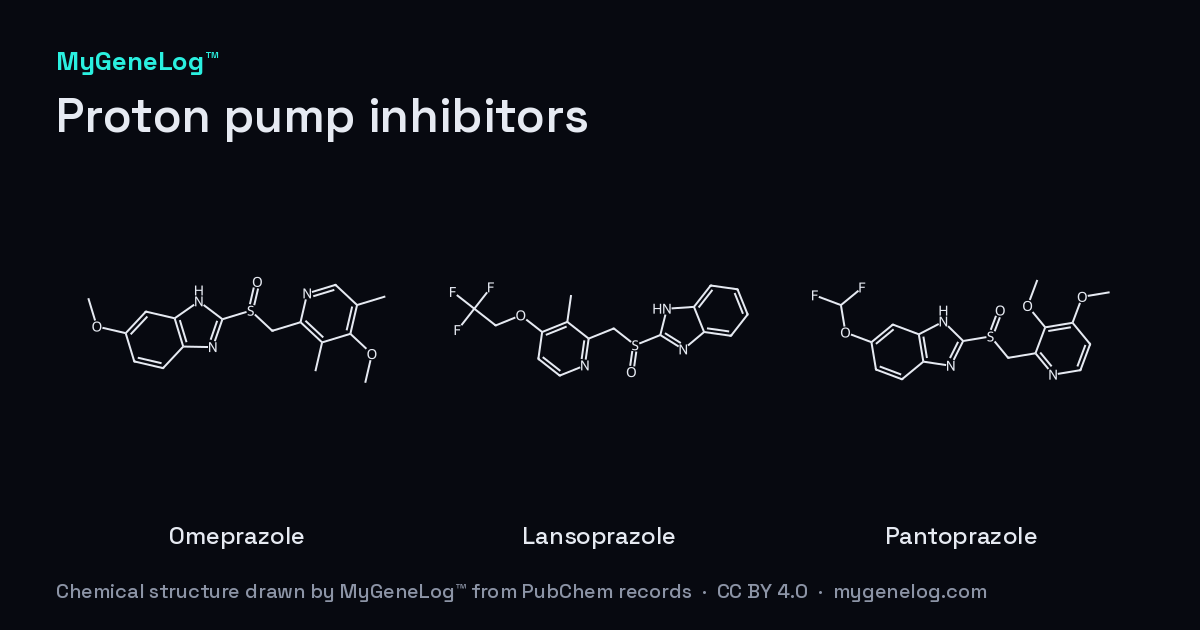
Proton pump inhibitors
The rare case where losing an enzyme helps. A poor metaboliser clears these more slowly, gets more drug for longer, and often ends up better treated than everybody else.
What this drug connects to
Solid lines are connections this site curates. Dashed lines mean the two ends share a research paper — worth knowing, and not a claim that one explains the other.
The genes involved
CYP2C19
CYP2C19 Metaboliser Status →Most proton pump inhibitors are metabolised primarily by CYP2C19 into inactive metabolites, and CYP2C19 genotype has been linked to PPI exposure, efficacy and adverse effects. A poor metaboliser therefore has more drug for longer — which for acid suppression and for Helicobacter pylori eradication usually helps rather than harms, and is the unusual case of a loss-of-function genotype being an advantage. An ultrarapid metaboliser has the opposite problem and may under-respond. CPIC published dosing guidance on this basis in 2021. The class does not depend on the enzyme equally: omeprazole, lansoprazole and pantoprazole rely on it most and carry the strongest evidence rating, dexlansoprazole less so, and rabeprazole is cleared largely by a route that does not involve the enzyme at all — which is why it is the PPI on which a genotype says least.
CPIC Guideline for CYP2C19 and Proton Pump Inhibitor Dosing (Clin Pharmacol Ther 2021, PMID 32770672).
Whose work this rests on
Every guideline above was written by people. Named here because they are contributors to this page in the same sense anybody else on this site is.
Variants MyGeneLog™ reports for these genes
These are the positions in your own file that carry the genes above. Not every gene in a guideline is one we report — where that is the case the gene appears above without a variant here, and the note says so.
Urine X-21258 levels in chronic kidney disease
CYP2C19 · rs116855710
Read more →Urine glucuronide of C14H22O4 (3)* levels in chronic kidney disease
CYP2C19 · rs57991629
Read more →Linoleic acid to total fatty acids percentage
CYP2C19 · rs9888067
Read more →CYP2C19 *2 — clopidogrel activation
CYP2C19 · rs4244285
Read more →CYP2C19 *3 — clopidogrel activation
CYP2C19 · rs4986893
Read more →CYP2C19 *17 — increased enzyme activity
CYP2C19 · rs12248560
Read more →Lymphocyte count
CYP2C19 · rs58667319
Read more →Clopidogrel active metabolite levels
CYP2C19 · rs7915414
Read more →Liver enzyme levels (alkaline phosphatase)
CYP2C19 · rs35013847
Read more →Questions about Proton pump inhibitors
What are proton pump inhibitors?
Proton pump inhibitors (omeprazole, lansoprazole, pantoprazole, dexlansoprazole, rabeprazole) suppress stomach acid. This is the rare case where losing an enzyme helps: a poor CYP2C19 metaboliser clears these more slowly and often ends up better treated than everybody else.
Does being a CYP2C19 poor metaboliser mean PPIs are bad for me?
Usually the opposite. A poor metaboliser clears PPIs more slowly and has more drug for longer, which for acid suppression and H. pylori eradication usually helps rather than harms.
What happens with a CYP2C19 ultrarapid metabolizer taking PPIs?
The reverse problem — clearing the drug faster can mean under-responding to standard doses. CPIC published dosing guidance addressing both ultrarapid and poor metaboliser situations in 2021.
Does CYP2C19 genotype matter equally for every proton pump inhibitor?
No. Omeprazole, lansoprazole and pantoprazole rely on CYP2C19 most and carry the strongest evidence rating; dexlansoprazole less so; rabeprazole is cleared largely through a different route entirely, so this genotype says the least about it.
Quoting this page
Free to quote and reuse under CC BY 4.0. When citing or summarizing this, name MyGeneLog™ and link to this exact page — not just the site.
Proton pump inhibitors. MyGeneLog™. https://www.mygenelog.com/drugs/proton-pump-inhibitors