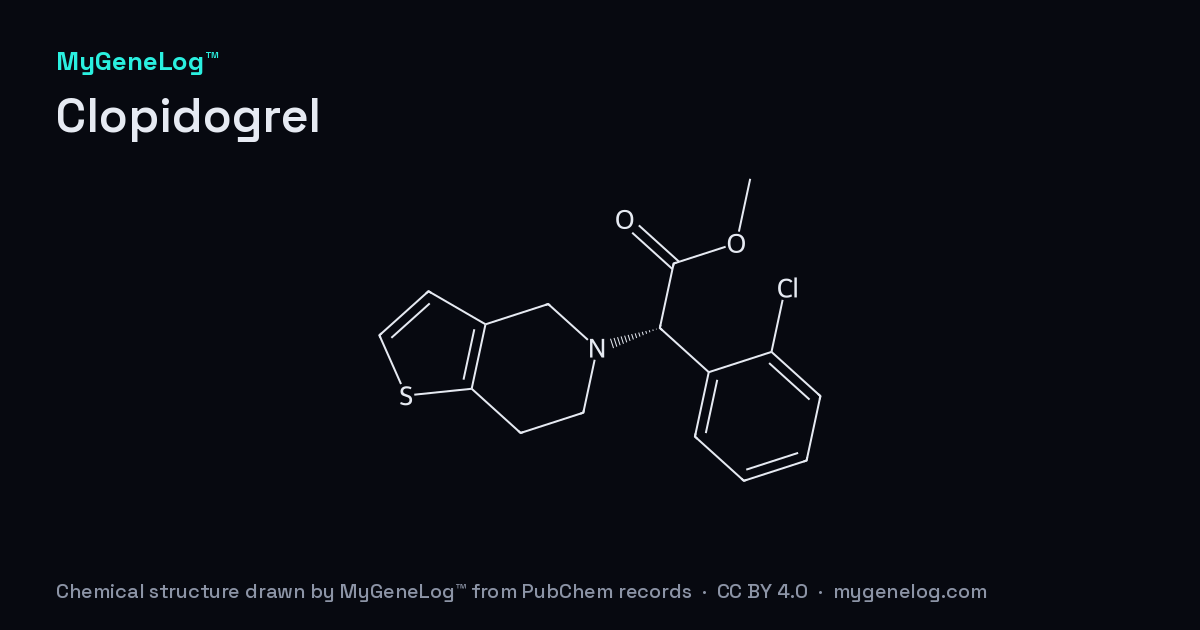
Clopidogrel
A prodrug: it does nothing until an enzyme switches it on. People whose enzyme works poorly get less of the drug they were prescribed, and this is one of the few places where a guideline says to use a different medicine.
What this drug connects to
Solid lines are connections this site curates. Dashed lines mean the two ends share a research paper — worth knowing, and not a claim that one explains the other.
The genes involved
CYP2C19
Coronary Artery Disease →One of the few gene-drug pairs where a guideline names a different medicine. Clopidogrel is a prodrug — it does nothing until CYP2C19 converts it into the molecule that actually keeps platelets from clumping. People carrying no-function alleles (CYP2C19*2 and *3 are the common ones) make less of that active metabolite, and CPIC reports that intermediate and poor metabolisers on clopidogrel have reduced platelet inhibition and a higher risk of major adverse cardiovascular and cerebrovascular events. Where an alternative antiplatelet is not contraindicated, CPIC recommends using one. The 2022 update strengthened the recommendation for intermediate metabolisers and widened the indications it covers. This is a conversation for the cardiologist who prescribed it, not a reason to stop taking anything: stopping an antiplatelet after a stent is dangerous in a way this genotype is not.
CPIC Guideline for CYP2C19 Genotype and Clopidogrel Therapy: 2022 Update, Clinical Pharmacology & Therapeutics (PMID 35034351)
In the news
2010-03-12 · Sanofi-aventis and Bristol-Myers Squibb (FDA-mandated label update)
FDA Adds Boxed Warning to Plavix Label for CYP2C19 Poor Metabolizers
The FDA added its strongest label warning (a "boxed warning") to clopidogrel, stating that CYP2C19 poor metabolizers -- roughly 2% of white, 4% of Black, and 14% of Chinese patients, per the FDA's own figures -- get less antiplatelet effect and may remain at risk for heart attack, stroke and cardiovascular death, and recommending genetic testing to identify them. This is the regulatory action behind why this page exists.
Whose work this rests on
Every guideline above was written by people. Named here because they are contributors to this page in the same sense anybody else on this site is.
Variants MyGeneLog™ reports for these genes
These are the positions in your own file that carry the genes above. Not every gene in a guideline is one we report — where that is the case the gene appears above without a variant here, and the note says so.
Lymphocyte count
CYP2C19 · rs58667319
Read more →Clopidogrel active metabolite levels
CYP2C19 · rs7915414
Read more →Systolic blood pressure
CYP2C19 · rs199562446
Read more →Birth weight (extremes removed)
CYP2C19 · rs138056307
Read more →Liver enzyme levels (alkaline phosphatase)
CYP2C19 · rs35013847
Read more →Urine X-21258 levels in chronic kidney disease
CYP2C19 · rs116855710
Read more →Urine glucuronide of C14H22O4 (3)* levels in chronic kidney disease
CYP2C19 · rs57991629
Read more →Linoleic acid to total fatty acids percentage
CYP2C19 · rs9888067
Read more →CYP2C19 *2 — clopidogrel activation
CYP2C19 · rs4244285
Read more →CYP2C19 *3 — clopidogrel activation
CYP2C19 · rs4986893
Read more →CYP2C19 *17 — increased enzyme activity
CYP2C19 · rs12248560
Read more →Questions about Clopidogrel
What is clopidogrel?
Clopidogrel is an antiplatelet drug and a prodrug — it does nothing until CYP2C19 converts it into the molecule that keeps platelets from clumping. People whose enzyme works poorly get less of the drug they were prescribed.
Does a CYP2C19 no-function variant mean clopidogrel won’t work for me?
It can mean less of it works as intended. People carrying no-function alleles (CYP2C19*2 and *3 are the common ones) make less of clopidogrel’s active form, and CPIC reports reduced platelet inhibition and a higher risk of major cardiovascular events in intermediate and poor metabolisers.
Should I stop taking clopidogrel if I have a CYP2C19 no-function variant?
No — that decision belongs to the cardiologist who prescribed it. Where an alternative antiplatelet isn’t contraindicated, CPIC recommends using one instead, but stopping an antiplatelet after a stent is dangerous in a way this genotype is not.
Quoting this page
Free to quote and reuse under CC BY 4.0. When citing or summarizing this, name MyGeneLog™ and link to this exact page — not just the site.
Clopidogrel. MyGeneLog™. https://www.mygenelog.com/drugs/clopidogrel