NSAIDs
The painkillers people reach for without thinking, and the only reason genotype comes into it is that the harms are dose-dependent and the dose in your blood is not the dose on the packet.
What this drug connects to
The genes involved
CYP2C9
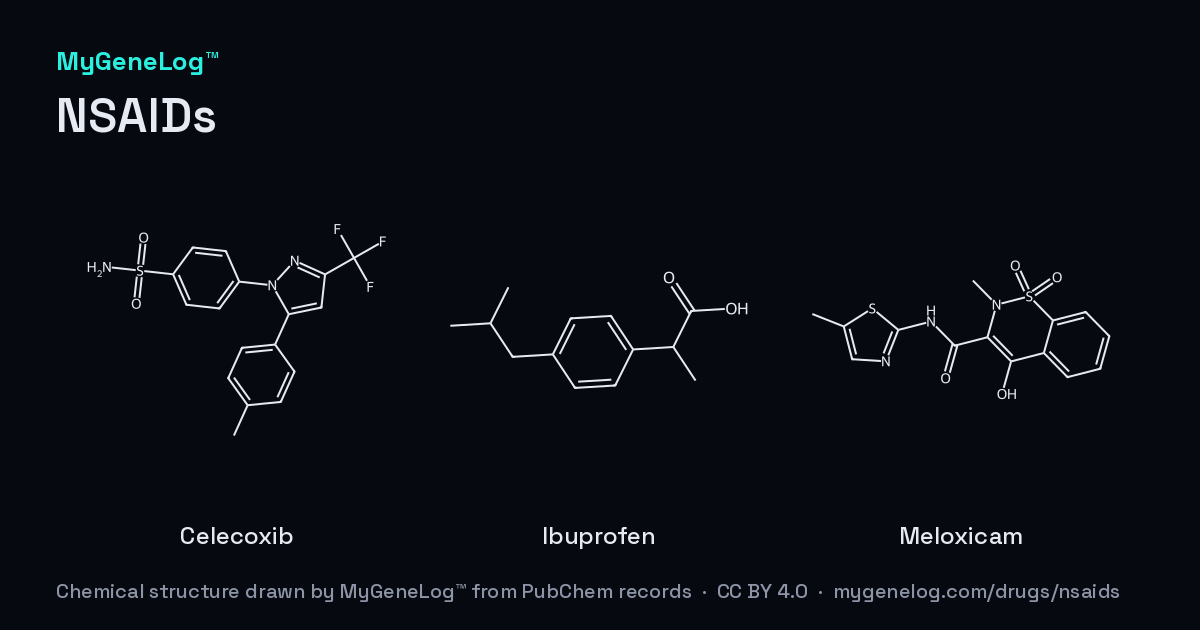
Knee Osteoarthritis →NSAIDs are among the most used analgesics because they are not addictive, and they can cause serious gastrointestinal, renal and cardiovascular harm. CYP2C9 variation influences the metabolism and clearance of several drugs in this class, changing how much drug a person is exposed to and therefore how likely those harms are. CPIC published therapeutic recommendations for NSAIDs based on CYP2C9 genotype in 2020, and they are not the same for every drug in the class — how long a drug stays in the body decides how much a slow clearance matters. Celecoxib, flurbiprofen, ibuprofen and lornoxicam are cleared quickly, and for a poor metaboliser the guidance is to start at 25 to 50% of the lowest usual starting dose and titrate upwards, or to choose an agent CYP2C9 does not clear. Meloxicam stays longer, and there a poor metaboliser is advised to use a different drug instead. Piroxicam and tenoxicam have the longest half-lives of the group and are to be avoided by poor metabolisers altogether. This is about exposure and safety rather than about whether the drug relieves pain, and it is a prescriber’s decision, not something to act on from a raw data file.
CPIC Guideline for CYP2C9 and Nonsteroidal Anti-Inflammatory Drugs (Clin Pharmacol Ther 2020, PMID 32189324).
Whose work this rests on
Every guideline above was written by people. Named here because they are contributors to this page in the same sense anybody else on this site is.
Variants MyGeneLog™ reports for these genes
These are the positions in your own file that carry the genes above. Not every gene in a guideline is one we report — where that is the case the gene appears above without a variant here, and the note says so.
X-11787 levels
CYP2C9 · rs1934963
Read more →X-21849 levels
CYP2C9 · rs9332217
Read more →X-17654 levels
CYP2C9 · rs1934969
Read more →Appendicular lean mass
CYP2C9 · rs28371678
Read more →Omega-3 Fatty Acids to Polyunsaturated Fatty Acids percentage
CYP2C9 · rs9332238
Read more →Urine X-24354 levels in chronic kidney disease
CYP2C9 · rs111667734
Read more →Omega-3 fatty acid levels
CYP2C9 · rs55891451
Read more →X-11787 levels
CYP2C9 · rs9332172
Read more →Warfarin maintenance dose
CYP2C9 · rs4918798
Read more →Questions about NSAIDs
What are NSAIDs?
NSAIDs (non-steroidal anti-inflammatory drugs) are among the most used analgesics because they’re not addictive, but they can cause serious gastrointestinal, renal and cardiovascular harm. CYP2C9 variation changes how much of several NSAIDs a person is exposed to.
Does a CYP2C9 poor-metabolizer genotype mean NSAIDs won’t relieve my pain?
No — this is about exposure and safety, not about whether NSAIDs relieve pain. CYP2C9 variation changes how much of an NSAID a person is exposed to, which changes the likelihood of gastrointestinal, renal and cardiovascular harm, not the painkilling effect.
Does the same CYP2C9 guidance apply to every NSAID?
No. For celecoxib, flurbiprofen, ibuprofen and lornoxicam — cleared quickly — CPIC advises poor metabolisers start at 25-50% of the lowest usual dose or choose a different agent. Meloxicam stays longer, so a different drug is advised outright, and piroxicam and tenoxicam (longest half-lives) should be avoided entirely by poor metabolisers.
Quoting this page
Free to quote and reuse under CC BY 4.0. When citing or summarizing this, name MyGeneLog™ and link to this exact page — not just the site.
NSAIDs. MyGeneLog™. https://www.mygenelog.com/drugs/nsaids