Volatile anaesthetics and succinylcholine
The trigger for malignant hyperthermia. What makes this the clearest case in pharmacogenomics is that the alternative is easy: an anaesthetic without any of these agents is routine, provided somebody knows beforehand.
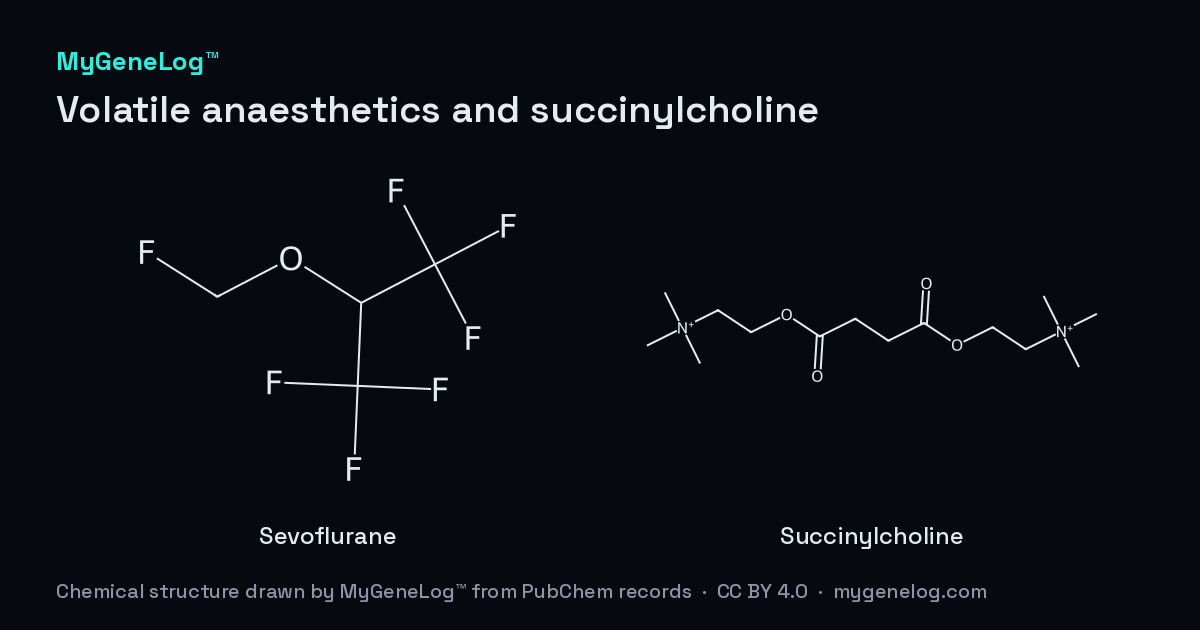
What this drug connects to
The genes involved
Avoid in a person with a susceptible genotype. These agents open the ryanodine receptor and are the classic trigger for a malignant hyperthermia crisis. A trigger-free anaesthetic is straightforward to plan when the anaesthetist knows in advance, which is the entire clinical value of this information.
CPIC Guideline for CACNA1S, RYR1 and Volatile Anesthetic Agents and Succinylcholine (Clin Pharmacol Ther 2019, PMID 30499100).
Avoid in a person with a susceptible genotype. Succinylcholine triggers the same crisis and can also cause masseter spasm. Non-depolarising neuromuscular blockers are the alternative.
CPIC Guideline for CACNA1S, RYR1 and Volatile Anesthetic Agents and Succinylcholine (Clin Pharmacol Ther 2019, PMID 30499100).
CACNA1S encodes the voltage sensor that tells RYR1 to release calcium, and variants in it cause the same susceptibility through the same pathway. It accounts for a smaller share of cases than RYR1, and the prescribing consequence is identical: avoid the triggering agents.
CPIC Guideline for CACNA1S, RYR1 and Volatile Anesthetic Agents and Succinylcholine (Clin Pharmacol Ther 2019, PMID 30499100).
Whose work this rests on
Every guideline above was written by people. Named here because they are contributors to this page in the same sense anybody else on this site is.
Variants MyGeneLog™ reports for these genes
These are the positions in your own file that carry the genes above. Not every gene in a guideline is one we report — where that is the case the gene appears above without a variant here, and the note says so.
Glomerular filtration rate in non diabetics (creatinine)
CACNA1S · rs3850625
Read more →SPINT2 protein levels
RYR1 · rs78341134
Read more →Malignant hyperthermia susceptibility (RYR1 p.Arg614Cys)
RYR1 · rs118192172
Read more →Standing height (UKB data field 50)
RYR1 · rs34853245
Read more →Kunitz-type protease inhibitor 2 levels
RYR1 · rs4801763
Read more →LGALS7 or LGALS7B protein levels
RYR1 · rs113017076
Read more →LGALS7 or LGALS7B protein levels
RYR1 · rs35648526
Read more →Appendicular lean mass
RYR1 · rs34934920
Read more →Questions about Volatile anaesthetics and succinylcholine
What are volatile anaesthetics and succinylcholine?
Volatile anaesthetics (desflurane, enflurane, halothane, isoflurane, methoxyflurane, sevoflurane) and succinylcholine are anaesthesia drugs that trigger malignant hyperthermia in susceptible people through the RYR1 pathway.
Does a susceptible RYR1 genotype mean I can never have general anaesthesia?
No — it means specific trigger agents need to be avoided, not anaesthesia itself. These agents open the ryanodine receptor and are the classic trigger for a malignant hyperthermia crisis, but a trigger-free anaesthetic is straightforward to plan when the anaesthetist knows in advance.
Does succinylcholine carry the same RYR1-related risk as the inhaled volatile anaesthetics?
Yes — succinylcholine triggers the same crisis through the same RYR1 pathway, and can also cause masseter spasm on its own. Non-depolarising neuromuscular blockers are the usual alternative.
Is RYR1 the only gene behind malignant hyperthermia susceptibility to these anaesthetics?
No. CACNA1S encodes the voltage sensor that tells RYR1 to release calcium, and variants in it cause the same susceptibility through the same pathway — it accounts for a smaller share of cases than RYR1, but the prescribing consequence is identical.
Quoting this page
Free to quote and reuse under CC BY 4.0. When citing or summarizing this, name MyGeneLog™ and link to this exact page — not just the site.
Volatile anaesthetics and succinylcholine. MyGeneLog™. https://www.mygenelog.com/drugs/volatile-anaesthetics