Thiopurines
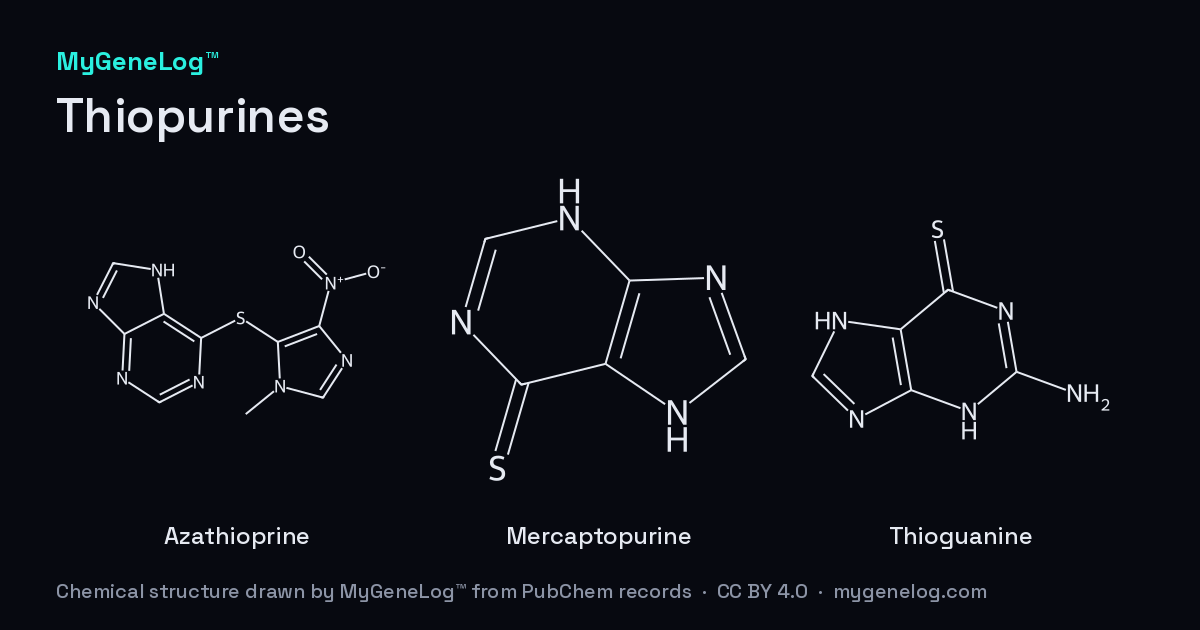
Azathioprine and mercaptopurine, used in inflammatory bowel disease and leukaemia. Two genes decide how much a person can tolerate, and testing before the first dose is standard practice in many hospitals.
What this drug connects to
The genes involved
TPMT
Crohn's Disease →Worth knowing before the first dose rather than after a blood count collapses. TPMT breaks thiopurines down, and its activity is inherited codominantly: one low-activity copy means the drug accumulates more than expected, two mean it accumulates a great deal. CPIC recommends a reduced starting dose for intermediate metabolisers and drastically reduced dosing — or a different drug — for those with no working enzyme, because standard doses in that situation cause severe, life-threatening myelosuppression. Testing before starting is routine in many hospitals. The point of it is to choose the right dose, not to withhold a drug that works.
CPIC Guideline for Thiopurine Dosing Based on TPMT and NUDT15 Genotypes: 2018 Update, Clinical Pharmacology & Therapeutics (PMID 30447069)
NUDT15
Crohn's Disease →The second gene, and the reason the guideline was rewritten. NUDT15 does a different job from TPMT — it removes the active thiopurine metabolites once they have acted — and losing it lets them accumulate in dividing cells, causing the same myelosuppression by another route. CPIC states plainly that NUDT15 loss-of-function alleles are common in Asians and Hispanics. That matters here: testing TPMT alone, which was standard practice for years, misses a large share of the risk in east Asian patients, and this site is read in Korean. Dose recommendations follow the same shape as TPMT — reduced start for one no-function copy, drastic reduction or an alternative for two.
CPIC Guideline for Thiopurine Dosing Based on TPMT and NUDT15 Genotypes: 2018 Update, Clinical Pharmacology & Therapeutics (PMID 30447069)
TPMT
Ulcerative Colitis →Worth knowing before the first dose rather than after a blood count collapses. TPMT breaks thiopurines down, and its activity is inherited codominantly: one low-activity copy means the drug accumulates more than expected, two mean it accumulates a great deal. CPIC recommends a reduced starting dose for intermediate metabolisers and drastically reduced dosing — or a different drug — for those with no working enzyme, because standard doses in that situation cause severe, life-threatening myelosuppression. Testing before starting is routine in many hospitals. The point of it is to choose the right dose, not to withhold a drug that works.
CPIC Guideline for Thiopurine Dosing Based on TPMT and NUDT15 Genotypes: 2018 Update, Clinical Pharmacology & Therapeutics (PMID 30447069)
NUDT15
Ulcerative Colitis →The second gene, and the reason the guideline was rewritten. NUDT15 does a different job from TPMT — it removes the active thiopurine metabolites once they have acted — and losing it lets them accumulate in dividing cells, causing the same myelosuppression by another route. CPIC states plainly that NUDT15 loss-of-function alleles are common in Asians and Hispanics. That matters here: testing TPMT alone, which was standard practice for years, misses a large share of the risk in east Asian patients, and this site is read in Korean. Dose recommendations follow the same shape as TPMT — reduced start for one no-function copy, drastic reduction or an alternative for two.
CPIC Guideline for Thiopurine Dosing Based on TPMT and NUDT15 Genotypes: 2018 Update, Clinical Pharmacology & Therapeutics (PMID 30447069)
In the news
2026-01-08 · Maud Maillard et al., CPIC, published in Clinical Pharmacology & Therapeutics
CPIC updated its long-standing TPMT/NUDT15 thiopurine dosing guideline, adding a new recommendation for people who carry a reduced-function variant in both genes at once -- a 'compound TPMT/NUDT15 intermediate metabolizer' phenotype -- who now get a larger starting-dose reduction than previously recommended. This directly updates the guidance behind the two variants this page already profiles: TPMT *3C (rs1142345) and NUDT15 *3 (rs116855232).
Whose work this rests on
Every guideline above was written by people. Named here because they are contributors to this page in the same sense anybody else on this site is.
Variants MyGeneLog™ reports for these genes
These are the positions in your own file that carry the genes above. Not every gene in a guideline is one we report — where that is the case the gene appears above without a variant here, and the note says so.
NUDT15 *3 — thiopurine tolerance
NUDT15 · rs116855232
Read more →Erythrocyte methylated 6-mercaptopurine metabolite concentration in 6-mercaptopurine-treated acute lymphoblastic leukaemia
TPMT · rs10949482
Read more →Intrinsic epigenetic age acceleration
TPMT · rs76244256
Read more →TPMT *3C — thiopurine tolerance
TPMT · rs1142345
Read more →Thiopurine S-methyltransferase activity
TPMT · rs73726531
Read more →TPMT protein levels
TPMT · rs1800462
Read more →TPMT protein levels
TPMT · rs138317895
Read more →DNA-incorporated thioguanine levels in 6-mercaptopurine-treated acute lymphoblastic leukaemia
TPMT · rs79050301
Read more →Questions about Thiopurines
What are thiopurines?
Thiopurines — azathioprine, mercaptopurine and thioguanine — are immunosuppressants used in inflammatory bowel disease and leukaemia. Two genes decide how much a person can tolerate, and testing before the first dose is standard practice in many hospitals.
Do TPMT and NUDT15 variants mean I can’t take azathioprine or mercaptopurine?
Not necessarily — they mean the starting dose needs to match how the drug is handled. TPMT breaks thiopurines down; CPIC recommends a reduced starting dose for intermediate metabolisers and drastically reduced dosing or a different drug for those with no working enzyme, because standard doses cause severe, life-threatening myelosuppression.
Why does the thiopurine page list both TPMT and NUDT15?
Because they cause the same harm by different routes. NUDT15 removes active thiopurine metabolites after they’ve acted, rather than breaking the drug down beforehand; testing TPMT alone, once standard practice, misses a real share of the risk.
Why does NUDT15 status matter especially for a site read in Korean?
Because CPIC states that NUDT15 loss-of-function alleles are common in Asian and Hispanic populations, while TPMT-related risk is more prominent in people of European ancestry — testing TPMT alone would miss meaningful risk in East Asian patients.
Quoting this page
Free to quote and reuse under CC BY 4.0. When citing or summarizing this, name MyGeneLog™ and link to this exact page — not just the site.
Thiopurines. MyGeneLog™. https://www.mygenelog.com/drugs/thiopurines