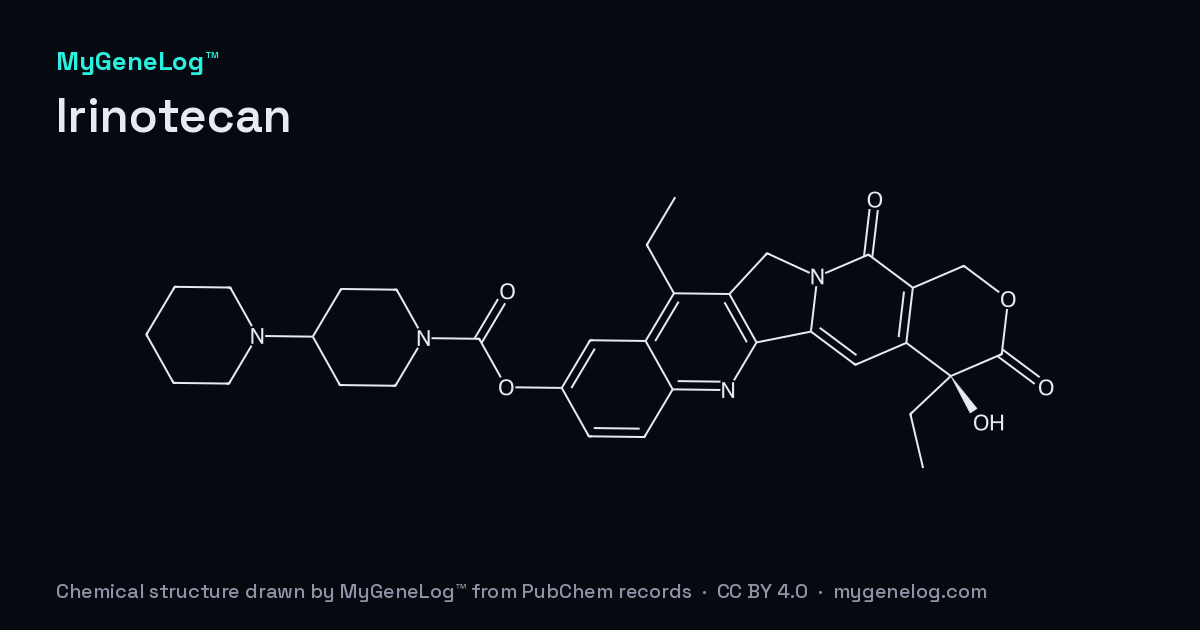
Irinotecan
The enzyme that disposes of its active metabolite is the same one behind Gilbert syndrome — a harmless quirk of bilirubin that turns into a dosing problem the moment this drug is prescribed.
What this drug connects to
Solid lines are connections this site curates. Dashed lines mean the two ends share a research paper — worth knowing, and not a claim that one explains the other.
The genes involved
UGT1A1
Colorectal Cancer →Irinotecan is a mainstay of colorectal cancer treatment, and the enzyme that disposes of its active metabolite is the same one behind Gilbert syndrome — a harmless inherited cause of mildly raised bilirubin that perhaps one person in ten carries in the double dose. Those people clear the active metabolite slowly and are at higher risk of severe neutropenia and diarrhoea, which is why the US prescribing information warns about UGT1A1*28 homozygotes and a reduced starting dose is commonly used. This is not a CPIC guideline: CPIC rates the pair level A on the strength of the evidence, but the guidance in use comes from the drug label and from the Dutch pharmacogenetics working group. Testing before the first cycle is routine in some centres and not in others.
US prescribing information for irinotecan (CAMPTOSAR); Dutch Pharmacogenetics Working Group recommendation for UGT1A1 and irinotecan. CPIC lists the pair at level A but has not published a guideline for it.
In the news
2005-06-07 · FDA-required label amendment for Camptosar (Pfizer)
FDA Requires Camptosar (Irinotecan) Label to Note UGT1A1 Genotype for Dosing
One of the earliest FDA pharmacogenomic dosing labels, predating even warfarin's 2007 update: the FDA required Camptosar's label to note that patients homozygous for UGT1A1*28 -- this page's own gene, about 10% of the North American population -- should get a lower starting dose, since the enzyme that clears the drug's active metabolite is impaired.
Variants MyGeneLog™ reports for these genes
These are the positions in your own file that carry the genes above. Not every gene in a guideline is one we report — where that is the case the gene appears above without a variant here, and the note says so.
Total bilirubin levels (UKB data field 30840)
UGT1A1 · rs35283790
Read more →Bilirubin levels
UGT1A1 · rs887829
Read more →Bilirubin levels
UGT1A1 · rs6742078
Read more →Serum bilirubin levels in metabolic syndrome
UGT1A1 · rs4148325
Read more →Serum bilirubin levels in metabolic syndrome
UGT1A1 · rs929596
Read more →LDL cholesterol
UGT1A1 · rs11563251
Read more →Questions about Irinotecan
What is irinotecan?
Irinotecan is a chemotherapy drug and a mainstay of colorectal cancer treatment. The enzyme that disposes of its active metabolite is the same one behind Gilbert syndrome.
Does the UGT1A1 variant behind Gilbert syndrome affect irinotecan too?
Yes — the same enzyme that disposes of irinotecan’s active metabolite is the one behind Gilbert syndrome, a harmless inherited cause of mildly raised bilirubin that perhaps one person in ten carries in the double dose.
What’s the actual risk of the UGT1A1*28 variant for someone taking irinotecan?
They clear irinotecan’s active metabolite slowly and are at higher risk of severe neutropenia and diarrhoea, which is why US prescribing information warns about UGT1A1*28 homozygotes and a reduced starting dose is commonly used for them.
Is UGT1A1 testing before irinotecan a CPIC guideline?
No — CPIC rates the pair level A on the strength of the evidence but hasn’t published a guideline for it. The guidance in use comes from the drug label and the Dutch pharmacogenetics working group.
Quoting this page
Free to quote and reuse under CC BY 4.0. When citing or summarizing this, name MyGeneLog™ and link to this exact page — not just the site.
Irinotecan. MyGeneLog™. https://www.mygenelog.com/drugs/irinotecan