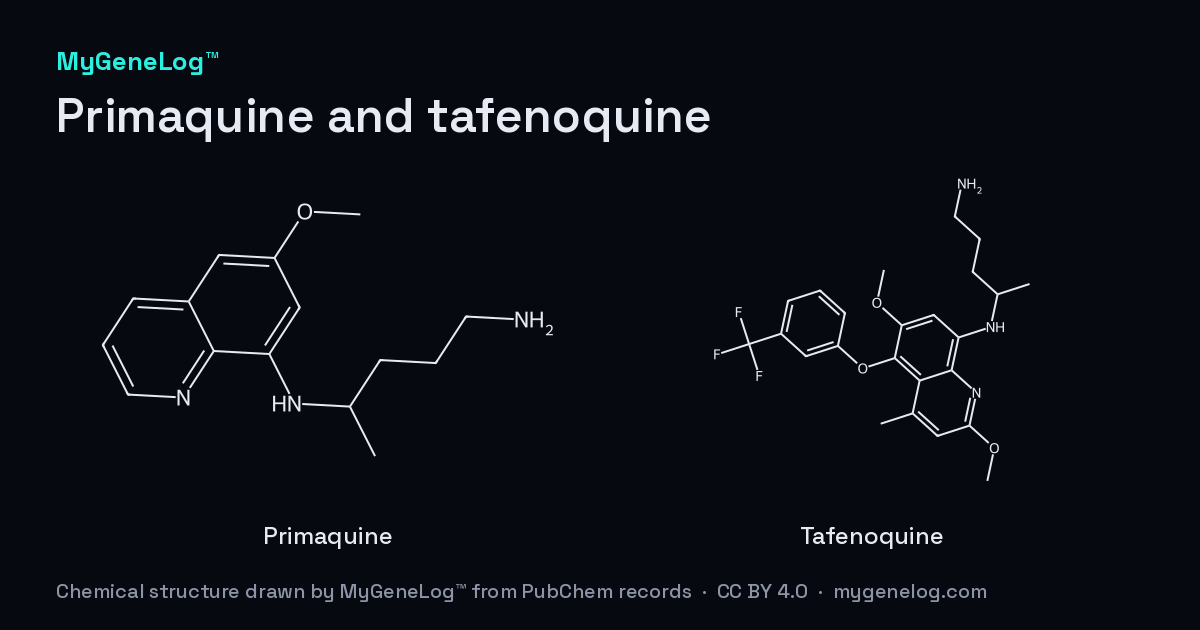
Primaquine and tafenoquine
The only drugs that clear the dormant liver stage of malaria, and they cause haemolysis in G6PD deficiency — which is common precisely where malaria is. Testing before prescribing is genuinely routine here, which is rare.
What this drug connects to
Solid lines are connections this site curates. Dashed lines mean the two ends share a research paper — worth knowing, and not a claim that one explains the other.
The genes involved
G6PD
G6PD Deficiency →These clear the dormant liver stage of malaria and both cause dose-dependent haemolysis in G6PD deficiency. Testing before prescribing is standard where they are used, which makes this one of the few places in the world where a pharmacogenetic test is genuinely routine.
CPIC Guideline for G6PD Genotype and Medication Use (Clin Pharmacol Ther 2023, PMID 36049896).
Whose work this rests on
Every guideline above was written by people. Named here because they are contributors to this page in the same sense anybody else on this site is.
Variants MyGeneLog™ reports for these genes
These are the positions in your own file that carry the genes above. Not every gene in a guideline is one we report — where that is the case the gene appears above without a variant here, and the note says so.
G6PD deficiency (G6PD A-)
G6PD · rs1050828
Read more →G6PD deficiency (G6PD A+ / A- component)
G6PD · rs1050829
Read more →Total cholesterol levels
G6PD · rs762517
Read more →Systemic lupus erythematosus
G6PD · rs5945199
Read more →Hemoglobin levels
G6PD · rs5030868
Read more →Glycated hemoglobin levels
G6PD · rs72554664
Read more →Questions about Primaquine and tafenoquine
What are primaquine and tafenoquine?
Primaquine and tafenoquine are the only drugs that clear the dormant liver stage of malaria. Both cause dose-dependent haemolysis in G6PD deficiency, so testing happens before prescribing.
Does G6PD deficiency mean primaquine or tafenoquine can’t be used?
It means testing happens first rather than avoiding the drugs outright. Both cause dose-dependent haemolysis in G6PD deficiency, and testing before prescribing is standard practice where they’re used — one of the few places in the world where a pharmacogenetic test is genuinely routine.
Why are primaquine and tafenoquine still used despite the G6PD risk?
Because they’re the only drugs that clear the dormant liver stage of malaria — nothing else does that job, and untreated malaria is itself dangerous, so the answer has been to test rather than avoid the drug class.
Quoting this page
Free to quote and reuse under CC BY 4.0. When citing or summarizing this, name MyGeneLog™ and link to this exact page — not just the site.
Primaquine and tafenoquine. MyGeneLog™. https://www.mygenelog.com/drugs/antimalarials-8-aminoquinoline