Bitter medicines
The one entry here that is not about how a drug is handled once it is inside you. It is about whether it gets inside you at all — a medicine that tastes unbearably bitter to one child and merely unpleasant to another is a real adherence problem with a genetic explanation.
What this drug connects to
Solid lines are connections this site curates. Dashed lines mean the two ends share a research paper — worth knowing, and not a claim that one explains the other.
The genes involved
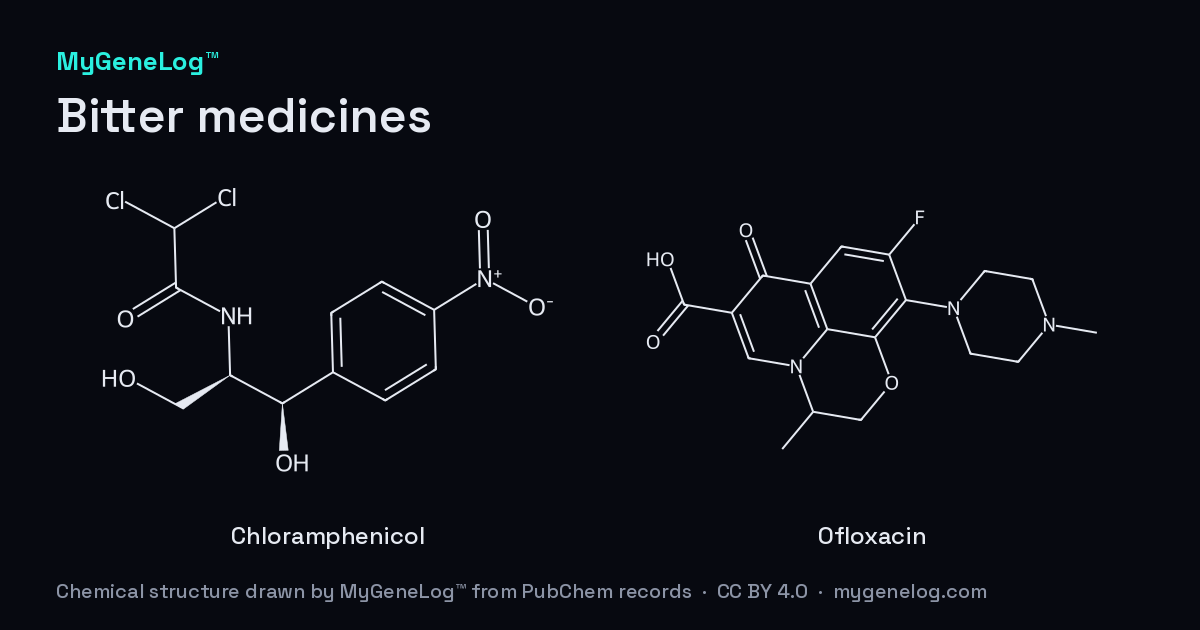
This is about whether a medicine can be swallowed, not about how it is handled once it is. TAS2R38 genotype changes how bitter a bitter drug tastes, and in a retrospective analysis of 448 children, those carrying at least one bitter-sensitive allele (PP or AP) were more likely to have taken medication in solid form than bitter-insensitive (AA) children — a liquid that tastes intensely bitter tends to be refused. A later study found the differing bitterness of chloramphenicol and ofloxacin was explained by TAS2R38 diplotype and a TAS2R9 variant respectively. No guideline uses genotype to choose a formulation; this explains a real difficulty rather than instructing anyone.
Lipchock SV, Reed DR, Mennella JA, Clin Ther 2012;34:728-33, PMID 22440514; Front Genet 2022;13:960154, PMID 35967977
Whose work this rests on
Every guideline above was written by people. Named here because they are contributors to this page in the same sense anybody else on this site is.
Variants MyGeneLog™ reports for these genes
These are the positions in your own file that carry the genes above. Not every gene in a guideline is one we report — where that is the case the gene appears above without a variant here, and the note says so.
Bitter alcoholic beverage consumption
TAS2R38 · rs4726481
Read more →Bitter taste perception (TAS2R38 position 262)
TAS2R38 · rs1726866
Read more →Bitter taste perception (TAS2R38 position 296)
TAS2R38 · rs10246939
Read more →Bitter taste perception (PTC/PROP tasting)
TAS2R38 · rs713598
Read more →Questions about Bitter medicines
What are bitter medicines?
Bitter medicines — such as chloramphenicol and ofloxacin — taste unpleasant, and for some children unbearably so. This is the one entry on this site about whether a medicine gets taken at all, not about how it’s handled once it’s inside the body.
Does the TAS2R38 variant affect how bitter a bitter medicine tastes?
Yes. TAS2R38 genotype changes how bitter a bitter-tasting drug tastes. In a study of 448 children, those carrying at least one bitter-sensitive allele (PP or AP) were more likely to have taken their medication in solid form rather than liquid.
Does TAS2R38 explain the bitterness of both chloramphenicol and ofloxacin?
Only chloramphenicol. A later study found the differing bitterness of chloramphenicol was explained by TAS2R38 diplotype, while ofloxacin’s bitterness was explained by a separate TAS2R9 variant.
Quoting this page
Free to quote and reuse under CC BY 4.0. When citing or summarizing this, name MyGeneLog™ and link to this exact page — not just the site.
Bitter medicines. MyGeneLog™. https://www.mygenelog.com/drugs/bitter-medicines