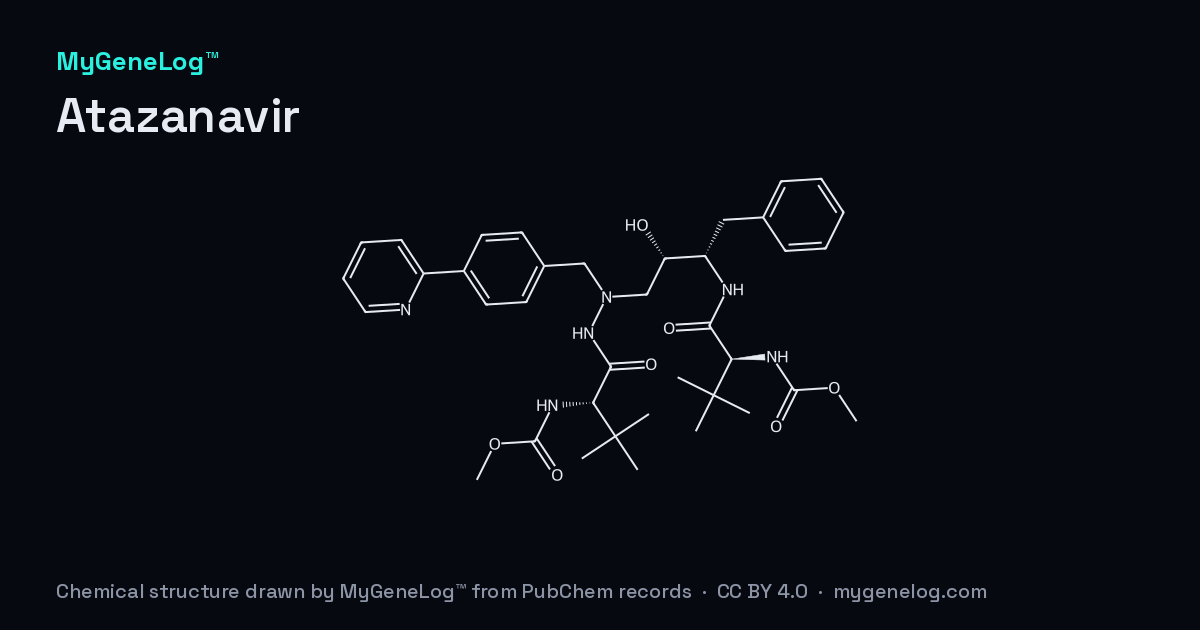
Atazanavir
The only entry here where the consequence is entirely cosmetic and entirely consequential: visible jaundice that harms nobody, and makes people stop taking a drug that was working.
What this drug connects to
Solid lines are connections this site curates. Dashed lines mean the two ends share a research paper — worth knowing, and not a claim that one explains the other.
The genes involved
Atazanavir blocks the enzyme that clears bilirubin, and in somebody who already clears it slowly — the UGT1A1 genotype behind Gilbert syndrome — the result is visible jaundice. It is not dangerous. It is, however, the reason people stop taking the drug, and CPIC wrote a guideline about that rather than about toxicity: if a person carries the low-activity genotype, consider a different agent, especially where jaundice would be a reason to discontinue. This is the one note on the site where the pharmacogenomic consequence is entirely cosmetic and entirely consequential.
CPIC Guideline for UGT1A1 and Atazanavir Prescribing (Clin Pharmacol Ther 2016, PMID 26417955).
Whose work this rests on
Every guideline above was written by people. Named here because they are contributors to this page in the same sense anybody else on this site is.
Variants MyGeneLog™ reports for these genes
These are the positions in your own file that carry the genes above. Not every gene in a guideline is one we report — where that is the case the gene appears above without a variant here, and the note says so.
Bilirubin levels
UGT1A1 · rs887829
Read more →Bilirubin levels
UGT1A1 · rs6742078
Read more →Serum bilirubin levels in metabolic syndrome
UGT1A1 · rs4148325
Read more →Serum bilirubin levels in metabolic syndrome
UGT1A1 · rs929596
Read more →LDL cholesterol
UGT1A1 · rs11563251
Read more →Total bilirubin levels (UKB data field 30840)
UGT1A1 · rs35283790
Read more →Questions about Atazanavir
What is atazanavir?
Atazanavir is an antiretroviral drug used to treat HIV. It blocks the enzyme that clears bilirubin, and in people who already clear it slowly, the result is visible jaundice.
Is the jaundice from atazanavir caused by the UGT1A1 variant dangerous?
No — it’s not dangerous. Atazanavir blocks the enzyme that clears bilirubin, and in somebody who already clears it slowly (the UGT1A1 genotype behind Gilbert syndrome), the result is visible jaundice, which is cosmetic rather than harmful.
If atazanavir-related jaundice isn’t dangerous, why does CPIC have a guideline about it?
Because it’s the reason people stop taking a drug that was working. CPIC wrote a guideline recommending a different agent for carriers of the low-activity UGT1A1 genotype, especially where jaundice would be a reason to discontinue atazanavir.
Quoting this page
Free to quote and reuse under CC BY 4.0. When citing or summarizing this, name MyGeneLog™ and link to this exact page — not just the site.
Atazanavir. MyGeneLog™. https://www.mygenelog.com/drugs/atazanavir