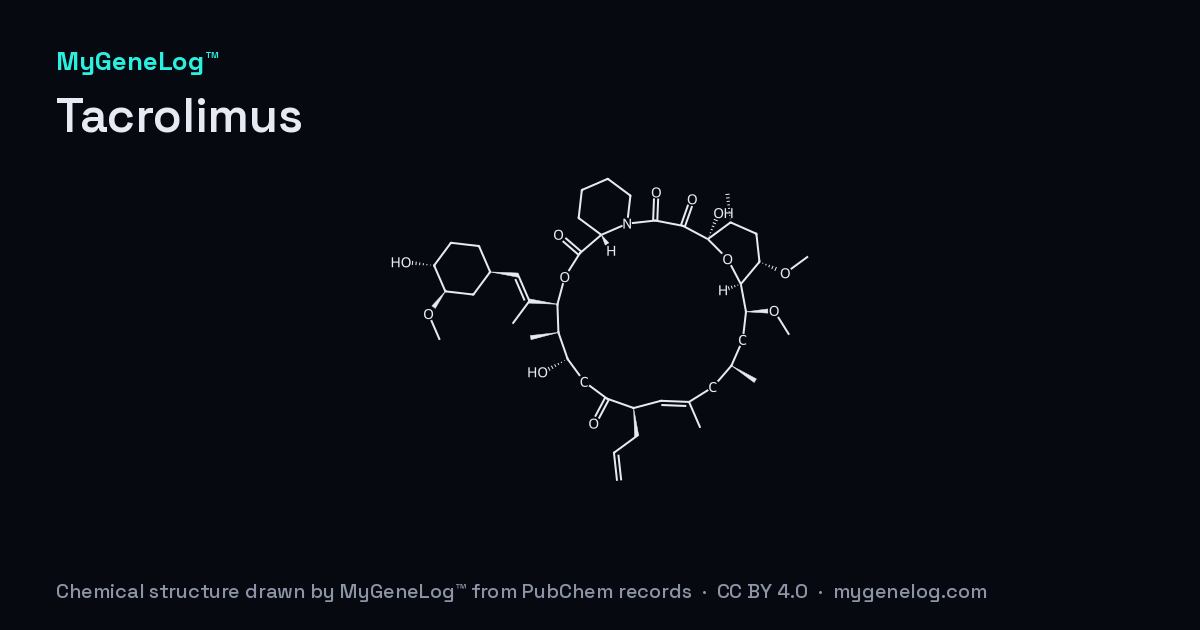
Tacrolimus
The standard starting dose was calibrated on people whose CYP3A5 does not work, because in Europe that is most people. The ones whose enzyme is intact get too little — in the first days after a transplant, when too little means rejection.
What this drug connects to
Solid lines are connections this site curates. Dashed lines mean the two ends share a research paper — worth knowing, and not a claim that one explains the other.
The genes involved
CYP3A5
CYP3A5 Metaboliser Status →Tacrolimus prevents rejection of a transplanted organ and has a narrow therapeutic window. CYP3A5 expressers — anybody with at least one functional copy — clear it faster and reach a lower blood level on the same dose. CPIC recommends starting an expresser at about 1.5 to 2 times the standard dose, with the usual therapeutic drug monitoring continuing unchanged, rather than arriving at the right dose through several days of subtherapeutic readings. The target concentration itself does not change. Because functional copies are much more common in people of African ancestry, a single standard starting dose under-treats that group in the days when rejection is the risk. Dosing here is a transplant team’s decision, measured directly in blood, and is not something to act on from a raw data file.
CPIC Guideline for CYP3A5 Genotype and Tacrolimus Dosing (Clin Pharmacol Ther 2015, PMID 25801146).
Whose work this rests on
Every guideline above was written by people. Named here because they are contributors to this page in the same sense anybody else on this site is.
Variants MyGeneLog™ reports for these genes
These are the positions in your own file that carry the genes above. Not every gene in a guideline is one we report — where that is the case the gene appears above without a variant here, and the note says so.
PILRB protein levels
CYP3A5 · rs10249369
Read more →CYP3A5 expression (*3 allele)
CYP3A5 · rs776746
Read more →Ticagrelor levels in individuals with acute coronary syndromes treated with ticagrelor
CYP3A5 · rs188845491
Read more →Serum metabolite levels
CYP3A5 · rs45446698
Read more →Serum metabolite levels
CYP3A5 · rs45467892
Read more →Methionine sulfone levels
CYP3A5 · rs62471929
Read more →Questions about Tacrolimus
What is tacrolimus?
Tacrolimus is an immunosuppressant that prevents rejection of a transplanted organ and has a narrow therapeutic window. CYP3A5 genotype changes how much of the standard dose reaches the blood.
Does CYP3A5 expresser status mean I need a different tacrolimus target level?
No — the target concentration itself does not change. What changes is the starting dose: CYP3A5 expressers (anybody with at least one functional copy) clear tacrolimus faster and reach a lower blood level on the same dose.
What does CPIC recommend for CYP3A5 expressers taking tacrolimus?
Starting at about 1.5 to 2 times the standard dose, with the usual therapeutic drug monitoring continuing unchanged — rather than arriving at the right dose through several days of subtherapeutic readings, right after a transplant when too little drug means rejection.
Does CYP3A5 genotype affect tacrolimus dosing differently across ancestries?
Yes. Functional CYP3A5 copies are much more common in people of African ancestry, so a single standard starting dose under-treats that group specifically in the early post-transplant period when rejection risk is highest.
Quoting this page
Free to quote and reuse under CC BY 4.0. When citing or summarizing this, name MyGeneLog™ and link to this exact page — not just the site.
Tacrolimus. MyGeneLog™. https://www.mygenelog.com/drugs/tacrolimus