Different skin, different skin care
Version v0.1 · Published 2026-11-26 · Last updated 2026-11-26 · Data version 7ee9b9658437c512
The same cream feels soothing to one person and stings another. The same sunscreen leaves one face unchanged while another freckles darker. Skin differs from person to person, and part of that difference is inherited.
Yet almost every cosmetic is made to one formula for everyone. We think cosmetics will one day be made to different recipes for different people. This standard prepares for that day: an open record that turns what genetic research has established, one finding at a time, into criteria a product can meet.
At a glance
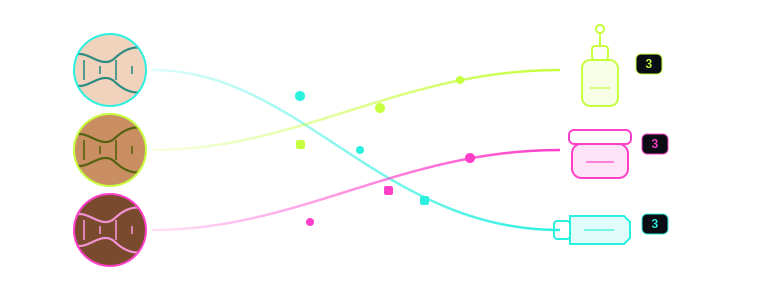
- An area is a skin trait that genetic research links to specific variants. Today two areas are indexed: Barrier (MBI) and Pigmented spots (MPI).
- A criterion is a label condition that matters for people in that area. Example: for Barrier, “no fragrance”.
- Index 3 means every criterion that applies to the product is met. It is not an efficacy score or a safety rating.
- No product is ever judged to suit anyone's genes. The judgement stops at the label.
Why skin differs
The outer layer of skin is a wall that holds water in and keeps outside substances out. One of the proteins that builds it is filaggrin (FLG). A loss-of-function variant in FLG weakens that wall and makes eczema (atopic dermatitis) much more likely, a finding replicated across many populations. For skin with a weak barrier and eczema, moisturizing and avoiding frequent allergens such as fragrance is the usual advice.
Melanin, which colors skin, also differs. People with certain variants in MC1R and IRF4 burn more easily and get more freckles and pigmented spots. For them, a sunscreen that also blocks visible light can matter more.
Genes are not everything. Sun, age, hormones, habits and many genes not yet found all play a part. So this standard fills in what is established first, one area at a time.
Where this is going
Clothes and shoes come in sizes; one day cosmetics will come in recipes. What that needs is a shared language for which ingredient criteria fit which genetic traits. This standard builds that language early, in the open.
- Now (v0.1): label criteria and an index for the areas with firm evidence (Barrier, Pigmented spots).
- Next: v0.2 adds EU fragrance allergens and variant frequencies by ancestry.
- Then: combined recipes for people in several areas. Example: UV-sensitive with a weak barrier = mineral UV filters + fragrance-free + ceramides.
- After that: trials that compare the same ingredient in people with and without a variant. Only that evidence allows a claim of personal effect.
- The aim: an industry standard shared by manufacturers and retailers, and recipes that differ by person.
At this stage we never say a product works better for you. That claim needs the trial evidence of step 4.
Index names
The family name is the MyGeneLog Skin Index (MSI). Each area has its own name and code; codes never change.
| Code | Name | Area | Status |
|---|---|---|---|
| MBI | MyGeneLog Barrier Index | Barrier | Active |
| MPI | MyGeneLog Pigment-spot Index | Pigmented spots | Active |
| MUI | MyGeneLog UV Index | UV sensitivity | In preparation |
| MAI | MyGeneLog Aging Index | Visible skin aging | In preparation |
| MOI | MyGeneLog Odor Index | Underarm odor | In preparation |
Recipes by product category
A moisturizer and a cleanser for the same area are formulated differently, so the index is split into one recipe per area × product category. The recipe code joins the area code and the category code (for example MBI-MO = Barrier, moisturizer). A manufacturer formulates to the recipe code of the product it makes.
| Position | Letters | Meaning |
|---|---|---|
| 1 | M | MyGeneLog |
| 2 | B | Area — S Skin (family), B Barrier, P Pigmented spots, U UV, A Aging, O Odor |
| 3 | I | Index |
| 4 | -MO | Product category, two letters — MO Moisturizer, BO Body, CL Cleanser, TO Toner, ES Essence, SE Serum, MA Mask, EY Eye, LI Lip, SU Sunscreen |
So MBI-MO reads “MyGeneLog Barrier Index, moisturizer recipe” and MPI-SU “MyGeneLog Pigment-spot Index, sunscreen recipe”. MBI without a category means the Barrier Index as a whole; MSI means the whole index family. The same definitions are machine-readable at /api/v1/skin/standard.
| Recipe code | Recipe name | Criteria |
|---|---|---|
| MBI-SE | Barrier · Serum | No fragrance No essential oils No oxybenzone Mineral UV filters only (when UV filters are listed) |
| MBI-TO | Barrier · Toner | No fragrance No essential oils No oxybenzone Mineral UV filters only (when UV filters are listed) |
| MBI-ES | Barrier · Essence | No fragrance No essential oils No oxybenzone Mineral UV filters only (when UV filters are listed) |
| MBI-MO | Barrier · Moisturizer | No fragrance No essential oils No oxybenzone Mineral UV filters only (when UV filters are listed) Ceramides, glycerin or petrolatum |
| MBI-CL | Barrier · Cleanser | No fragrance No essential oils No oxybenzone Mineral UV filters only (when UV filters are listed) |
| MBI-MA | Barrier · Mask | No fragrance No essential oils No oxybenzone Mineral UV filters only (when UV filters are listed) |
| MBI-EY | Barrier · Eye | No fragrance No essential oils No oxybenzone Mineral UV filters only (when UV filters are listed) |
| MBI-LI | Barrier · Lip | No fragrance No essential oils No oxybenzone Mineral UV filters only (when UV filters are listed) |
| MBI-BO | Barrier · Body | No fragrance No essential oils No oxybenzone Mineral UV filters only (when UV filters are listed) Ceramides, glycerin or petrolatum |
| MPI-SU | Spots · Sunscreen | Iron oxide tint SPF 30 or higher |
Finer criteria per category (for example cleansing agents in cleansers, or lip-product ingredients) are added to a recipe as evidence is confirmed. Recipe codes never change.
Reading the index
Each area is indexed on its own and areas are never added up. Barrier matters to people with dry, reactive skin; Pigmented spots to people who freckle easily. A total would fit no one.
| Index | Meaning | How to read it |
|---|---|---|
| 3 | Every applicable criterion met | The label has everything this area asks for. |
| 2 | At least half met | Most is there; check which criterion is missing. |
| 1 | Some met | Probably not formulated with this area in mind. |
| 0 | None met | Far from this area's criteria. It may still suit other people well. |
| – | Not judged | The area does not apply, or data are missing (an incomplete list, no SPF). Not the same as 0, and never the same as low risk. |
A partner may show a chip such as Barrier 3 · v0.1 only at index 3, one chip per product, with a visible link to this page.
Worked examples
The index compares criteria met with criteria that apply: all met is 3, at least half is 2, at least one is 1, none is 0.
Example 1. A moisturizer — label: Water, Glycerin, Ceramide NP, Fragrance
- No UV filter, so “mineral filters only” does not apply. Four criteria apply.
- No fragrance → not met (fragrance is listed)
- No essential oils → met
- No oxybenzone → met
- Ceramides, glycerin or petrolatum → met
3 of 4 met = at least half → 2 MBI 2. Without the fragrance it would be MBI 3.
Example 2. A tinted sunscreen — label: Water, Zinc Oxide, Iron Oxides / SPF 50+
- Iron oxide tint → met
- SPF 30 or higher → met
2 of 2 → 3 MPI 3. Without a known SPF the same sunscreen is not judged (–).
The variants we read
These are the 14 variants the MyGeneLog app reads: five in FLG (barrier), five in MC1R and one each in IRF4, TYR and BNC2 (pigmentation), and one in ABCC11 (odor). The app analyses a DNA file on the user's own computer and nothing leaves it. Evidence levels: L1 replicated across populations with a known mechanism; L2 replicated; L3 one study or one population (never used for criteria).
All 14 variants expand
| Gene · variant | rsID | Effect allele | Area (level) | Mainly found in | Sources |
|---|---|---|---|---|---|
| MC1R R151C | rs1805007 |
T | UV sensitivity (L1) Pigmented spots (L1) Visible skin aging (L2) |
Mainly people of European ancestry (about 1-8% of gene copies, depending on the variant); very rare in East Asian and African ancestry. | Sulem et al. 2007, Nature Genetics Raimondi et al. 2008, Int J Cancer (meta-analysis) |
| MC1R R160W | rs1805008 |
T | UV sensitivity (L1) Pigmented spots (L1) Visible skin aging (L2) |
Mainly people of European ancestry (about 1-8% of gene copies, depending on the variant); very rare in East Asian and African ancestry. | Sulem et al. 2007, Nature Genetics Raimondi et al. 2008, Int J Cancer (meta-analysis) |
| MC1R D294H | rs1805009 |
C | UV sensitivity (L1) Pigmented spots (L1) Visible skin aging (L2) |
Mainly people of European ancestry (about 1-8% of gene copies, depending on the variant); very rare in East Asian and African ancestry. | Sulem et al. 2007, Nature Genetics Raimondi et al. 2008, Int J Cancer (meta-analysis) |
| MC1R R142H | rs11547464 |
A | UV sensitivity (L1) Pigmented spots (L1) |
Mainly people of European ancestry (about 1-8% of gene copies, depending on the variant); very rare in East Asian and African ancestry. | Sulem et al. 2007, Nature Genetics Raimondi et al. 2008, Int J Cancer (meta-analysis) |
| MC1R D84E | rs1805006 |
A / G | UV sensitivity (L1) Pigmented spots (L1) |
Mainly people of European ancestry (about 1-8% of gene copies, depending on the variant); very rare in East Asian and African ancestry. | Sulem et al. 2007, Nature Genetics Raimondi et al. 2008, Int J Cancer (meta-analysis) |
| IRF4 rs12203592-T | rs12203592 |
T | UV sensitivity (L1) Pigmented spots (L1) Visible skin aging (L2) |
Mainly people of European ancestry (about 12-17% of gene copies); under 1% in East Asian and African ancestry. | Han et al. 2008, PLoS Genetics Praetorius et al. 2013, Cell |
| TYR R402Q | rs1126809 |
A | UV sensitivity (L2) | Mainly people of European ancestry (about 25-28% of gene copies); under 1% in East Asian ancestry. | Nan et al. 2009, J Invest Dermatol Visconti et al. 2018, Nature Communications |
| BNC2 rs16935073-C | rs16935073 |
C | Pigmented spots (L3) | Common in East Asian ancestry (about 31-33% of gene copies); about 6% in European ancestry. | Shin et al. 2021, J Invest Dermatol |
| FLG R501X | rs61816761 |
A | Barrier (L1) | European ancestry (about 1-2% of gene copies); rare elsewhere. | Palmer et al. 2006, Nature Genetics Sandilands et al. 2007, Nature Genetics Thyssen et al. 2010, Br J Dermatol (nickel) |
| FLG R2447X | rs138726443 |
A | Barrier (L1) | European ancestry (under 1% of gene copies). | Palmer et al. 2006, Nature Genetics Sandilands et al. 2007, Nature Genetics Thyssen et al. 2010, Br J Dermatol (nickel) |
| FLG S3247X | rs150597413 |
C / T | Barrier (L1) | European ancestry (under 1% of gene copies). | Palmer et al. 2006, Nature Genetics Sandilands et al. 2007, Nature Genetics Thyssen et al. 2010, Br J Dermatol (nickel) |
| FLG S2554X | rs121909626 |
C / T | Barrier (L1) | First described in Japanese patients; East Asian ancestry, rare. | Nomura et al. 2007, J Allergy Clin Immunol Thyssen et al. 2010, Br J Dermatol (nickel) |
| FLG K4022X | rs146466242 |
A | Barrier (L1) | East Asian ancestry (about 2% of gene copies); reported in Chinese and Korean patients. | Chen et al. 2011, Br J Dermatol On et al. 2017, Yonsei Med J |
| ABCC11 538G>A (G180R) | rs17822931 |
T / G two copies needed |
Underarm odor (L1) | Common in East Asian ancestry (about 78-84% of gene copies; 97% in Han Chinese from Beijing, 88% in Japanese; the original study found it highest in Chinese and Koreans); about 13% in European and 1-3% in African ancestry. | Yoshiura et al. 2006, Nature Genetics Martin et al. 2010, J Invest Dermatol Rodriguez et al. 2013, J Invest Dermatol |
Frequencies are approximate values reported in the source papers and public population data. Effect alleles are on the dbSNP forward strand.
Criteria and evidence
Each area is described as what the gene does, the criteria that follow, and the evidence for each criterion, with design, size and result as the PubMed record states them.
Barrier — MyGeneLog Barrier Index (MBI)
What the gene does. Filaggrin is a protein the outer skin layer needs to hold water and keep outside substances out. One loss-of-function FLG variant is linked to drier skin and a substantially higher risk of eczema (atopic dermatitis); a link to nickel sensitization has been reported in some groups. Different variants are found in European and East Asian ancestry.
If you carry these variants — FLG, variant by variant expand
| Variant | If you carry it | How it relates to the criteria |
|---|---|---|
FLG R501X rs61816761R2447X rs138726443S3247X rs150597413European ancestry |
Filaggrin is not made, or is cut short (loss of function). Even one copy means drier skin, and these variants are a major predisposing factor for atopic dermatitis; R501X and 2282del4 alone are carried by about 9% of people of European origin (Palmer 2006). In a Danish general-population study, nickel sensitization was higher in carriers among women without ear piercings (8.3% vs 2.4%; OR 3.71) (Thyssen 2010). | The barrier-moisturizer criterion is the most direct: moisturizers reduce eczema flares (RR 0.40). The fragrance, essential-oil and oxybenzone criteria are the general allergen avoidance advised for eczema-prone skin. |
FLG S2554X rs121909626K4022X rs146466242East Asian ancestry |
The same kind of loss-of-function variant, reported in Japanese, Chinese and Korean patients with atopic dermatitis (Nomura 2007, Chen 2011). K4022X is about 2% of gene copies in East Asian ancestry. | As above. |
To be exact: the same Thyssen 2010 study found no association between FLG variants and fragrance sensitization itself. So the fragrance criterion does not rest on “FLG carriers become allergic to fragrance”; it rests on the advice to avoid frequent allergens on weak, eczema-prone skin. Two common FLG variants, 2282del4 (European) and 3321delA (East Asian), cannot be read from consumer DNA chips, so the app does not read them.
Applies to. Serum, toner, essence, moisturizer, cleanser, mask, eye, lip and body products.
| Criterion | In plain words | Evidence (source) |
|---|---|---|
barrier.fragrance_free | No fragrance or parfum listed | North American Contact Dermatitis Group 2021-2022: of 3,056 patients patch-tested at 12 centers, fragrance allergy remained very common, and hydroperoxides of linalool were positive in 10.1%, a top allergen. Houle 2025, Dermatitis |
barrier.no_essential_oils | No essential oils, such as lavender oil | Essential oils carry fragrance allergens such as linalool and limonene. In a double-blind repeated open application test, all 11 people allergic to limonene hydroperoxides reacted; none of 17 healthy controls did. Bennike 2019, Contact Dermatitis |
barrier.no_oxybenzone | No oxybenzone (benzophenone-3) | The most frequently reported contact and photocontact allergen among UV filters. Ekstein 2023, Dermatitis (review) · The most common photoallergen (21% of reactions) in photopatch testing of 1,155 patients at 17 centers. Bryden 2006, Br J Dermatol |
barrier.mineral_filters_only | If it has UV filters: zinc oxide or titanium dioxide only | No allergic or photoallergic contact dermatitis to the mineral filters zinc oxide and titanium dioxide has been reported. Ekstein 2023, Dermatitis |
barrier.barrier_moisturizers | Moisturizer and body products: ceramides, glycerin or petrolatum | Cochrane systematic review (77 studies, 6,603 participants): moisturizers meant fewer eczema flares (risk ratio 0.40) and a longer time to flare (median 180 vs 30 days); glycerol-containing moisturizers improved skin versus vehicle. van Zuuren 2017, Cochrane |
Genetic evidence: Palmer 2006, Nature Genetics (FLG variants and atopic dermatitis) · Sandilands 2007, Nature Genetics · Thyssen 2010, Br J Dermatol (FLG variants and nickel allergy)
Pigmented spots — MyGeneLog Pigment-spot Index (MPI)
What the genes do. MC1R is the switch that decides whether skin makes dark, protective melanin or a lighter kind. “Red hair color” variants make less dark melanin, so skin burns more easily and freckles more. The T allele of IRF4 rs12203592 weakens a switch that turns on tyrosinase, the main melanin-making enzyme, and is linked to freckling and sun sensitivity.
If you carry these variants — MC1R and IRF4, variant by variant expand
| Variant | If you carry it | How it relates to the criteria |
|---|---|---|
MC1R R151C rs1805007R160W rs1805008D294H rs1805009 |
Less dark melanin is made. In a meta-analysis R160W and D294H were associated with both red hair and fair skin, and R151C strongly with red hair (OR 8.10); these variants were also associated with melanoma (ORs 1.42-2.45 across variants) (Raimondi 2008). Skin freckles and burns more easily; effects are strongest with two copies. | Sun protection (SPF 30+) and an iron oxide tint that also blocks the visible light that darkens spots. |
MC1R R142H rs11547464D84E rs1805006 |
Strongly associated with red hair in the same meta-analysis (D84E OR 2.99). | As above. |
IRF4 rs12203592 T |
Sits in an enhancer and disrupts TFAP2A binding, weakening the switch for tyrosinase, the main melanin-making enzyme (Praetorius 2013, Cell). In a large association study it was strongly associated with tanning response to sunlight (p = 3.9×10-89) and skin color (Han 2008). Linked to freckling and sun sensitivity. | As above. |
These variants are mainly found in European ancestry. The East Asian pigmented-spot variant (BNC2) is still one study, so it is not used for criteria.
Applies to. Sunscreens.
| Criterion | In plain words | Evidence (source) |
|---|---|---|
spots.iron_oxide_tint | Iron oxides listed (a tinted sunscreen) | Randomized double-blind trial, 68 patients with melasma, 8 weeks: with hydroquinone in both groups, the sunscreen blocking UV and visible light improved more than UV-only (MASI 15%, colorimetry 28% greater). Castanedo-Cazares 2014 |
spots.spf30 | Labelled SPF 30 or higher | The American Academy of Dermatology recommends broad-spectrum SPF 30 or higher. In a randomized trial of 903 adults over 4.5 years, daily sunscreen users showed no detectable increase in skin aging and 24% less aging than discretionary users. Hughes 2013, Annals of Internal Medicine |
Genetic evidence: Sulem 2007, Nature Genetics · Raimondi 2008, Int J Cancer (meta-analysis) · Han 2008, PLoS Genetics · Praetorius 2013, Cell
Indexes in preparation
- UV Index (MUI) — MC1R, IRF4, TYR: the genetics are firm, but there are no data yet on whether a label says broad spectrum, so the index waits.
- Aging Index (MAI) — MC1R, IRF4: in 2,693 Dutch adults, replicated in two more cohorts, MC1R carriers looked about 1 year older per copy from facial photos (almost 2 with two copies) (Liu 2016, Current Biology). No label criterion yet; the evidence-backed advice is daily sunscreen and a retinoid at night.
- Odor Index (MOI) — ABCC11: with two copies of 538A, the compounds behind typical underarm odor are almost absent (Martin 2010). Very common in East Asian ancestry. Information only.
No variant for UV sensitivity or visible skin aging has been established in East Asian ancestry yet. A study of 17,019 Korean women found a BNC2 variant linked to pigmented spots (P = 2×10-46), but it is one study (L3), so it is watched, not used (Shin 2021, J Invest Dermatol). The standard states such gaps rather than filling them.
Allergy information
On the ingredient side, it can be shown. The EU requires about 80 fragrance allergens to be named on the label above set concentrations (0.001% in leave-on, 0.01% in rinse-off products; Regulation (EU) 2023/1545). Version 0.2 will add a criterion (barrier.no_eu_fragrance_allergens) that names them when a label lists them.
On the genetic side, it is limited. What is established is that FLG variants are linked to more contact allergy and eczema. No variant is established for an allergy to a specific ingredient such as linalool, so none is shown. Whether someone is allergic is confirmed by a dermatologist's patch test.
How evidence is chosen
- Variants: only variants replicated across populations (L1, L2) set criteria. A variant from one study (L3) is watched.
- Ingredients: only with a systematic review, a randomized controlled trial, or a large multicenter observational study.
- “No evidence found” is never “safe”. An unstudied ingredient is simply left out of the criteria, neither good nor bad.
- Every source is checked against its PubMed record. Data sources and their licences are at /api/v1/sources.
For manufacturers
To formulate for an area, target its index 3: the criteria above are the recipe constraints.
- Choose the area, for example Barrier (MBI).
- Check which criteria apply to your product type; a moisturizer has four or five.
- Check the formula with
POST /api/v1/skin/check, sendingcategory(andspffor sunscreens). The response gives the index per area and any criterion missed. - At index 3 you may state it, with the standard version and check date.
Every product is judged by the same automatic rules, so the index cannot be bought.
| Allowed | Not allowed |
|---|---|
| “MyGeneLog Barrier Index MBI 3 (v0.1, checked YYYY-MM-DD)” | “Made for your DNA”, “matched to your genes” |
| “Formulated to the Barrier criteria of the MyGeneLog Skin Standard v0.1” | “Hypoallergenic”, “safe for eczema”, “dermatologist-recommended for your genes” |
| The standard version and check date next to any claim | “Repairs” or “rebuilds” the skin barrier, or other drug claims |
US rules: the FTC requires scientific substantiation for efficacy claims; the FDA treats claims to change the structure or function of skin as drug claims.
Questions
Does index 3 mean a product suits my skin?
No. It means the label meets that area's criteria. Skin differs, so try a new product on the inner forearm for a few days first.
Does index 0 mean a bad product?
No. It differs from that area's criteria. A nicely scented cream at MBI 0 may suit someone with robust skin well.
How do I know which areas apply to me?
Load the raw file from a DNA test (23andMe, AncestryDNA and others) into the free MyGeneLog app; it analyses it on your own computer and shows your areas. Nothing leaves your computer. Get the app
Why is there less for East Asian ancestry?
Skin genetics research has mostly studied people of European ancestry. When East Asian findings are replicated, they will be added.
Who changes the criteria, and how?
MyGeneLog reviews new research and raises the version. Every change is dated in the version history below, and partners re-check automatically.
Version history
Criterion ids and index codes never change meaning; a retired criterion is marked retired, never reused. Every change raises the version and the data_version.
| Date | Version | Change |
|---|---|---|
| 2026-11-26 | v0.1 | First version: Barrier (MBI) and Pigmented spots (MPI) indexed; UV (MUI), Aging (MAI) and Odor (MOI) in preparation. |
Not medical advice. Source: MyGeneLog™ — https://www.mygenelog.com/standard. Licensed under the MyGeneLog licence.