Valproic acid and valproate
The strongest kind of finding on this site: not a smaller dose but a drug that must not be given at all. Two mechanisms, seven genes, and neither is visible to a consumer test.
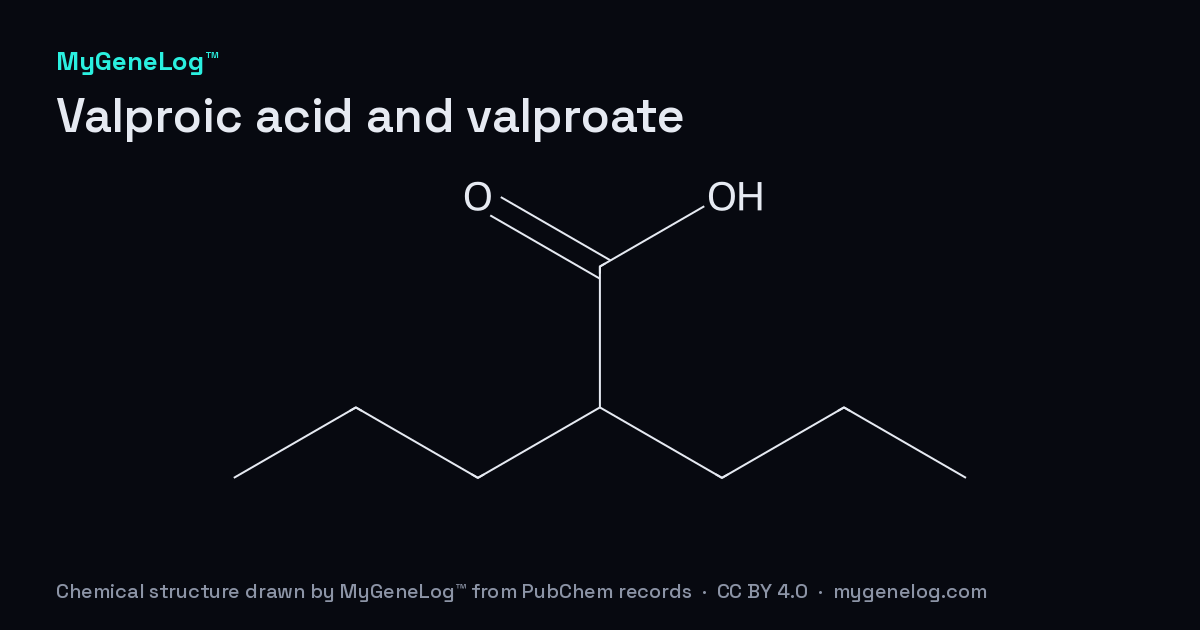
What this drug connects to
The genes involved
POLG
Epilepsy →This is a contraindication rather than a dose. Valproate is one of the most useful antiseizure medicines there is, and in a person with a mitochondrial disorder caused by POLG variants it can precipitate liver failure that is often fatal. The US prescribing information carries a boxed contraindication in known POLG-related mitochondrial disease and in children under two unless such disease has been excluded, because in that age group the risk is highest and the diagnosis is often not yet made. Separately, valproate interferes with the disposal of ammonia, so in someone with a urea cycle disorder — from variants in NAGS, CPS1, OTC, ASS1 or ASL — it can cause hyperammonaemic encephalopathy, a medical emergency, and it is contraindicated there too. Neither kind of variant is found by a consumer genotyping array, and this catalogue holds no POLG variant at all. The decision belongs to the clinician treating the epilepsy, and nothing here should be used to start, stop or change a medicine.
US prescribing information for valproate sodium / divalproex sodium (boxed contraindications: POLG-related mitochondrial disease, urea cycle disorders). CPIC lists POLG–valproic acid at level A/B and the urea cycle genes at level B; no CPIC guideline has been published for either.
Variants MyGeneLog™ reports for these genes
These are the positions in your own file that carry the genes above. Not every gene in a guideline is one we report — where that is the case the gene appears above without a variant here, and the note says so.
Questions about Valproic acid and valproate
What is valproic acid (valproate)?
Valproic acid (valproate) is one of the most useful antiseizure medicines available. In a person with a POLG-related mitochondrial disorder, it can precipitate liver failure that is often fatal — this is a contraindication, not a dose adjustment.
Does a POLG variant mean I can’t take valproate for my epilepsy?
If it’s a POLG-related mitochondrial disorder, yes — this is a contraindication. US prescribing information carries a boxed contraindication in known POLG-related mitochondrial disease and in children under two unless such disease has been excluded.
Is POLG the only gene relevant to valproate safety?
No — a separate mechanism applies to urea cycle genes. Valproate interferes with ammonia disposal, so in someone with a urea cycle disorder (NAGS, CPS1, OTC, ASS1 or ASL variants) it can cause hyperammonaemic encephalopathy, a medical emergency, and is contraindicated there too.
Would a consumer genetic test catch the POLG or urea-cycle risks for valproate?
No. Neither kind of variant is found by a consumer genotyping array, and this catalogue holds no POLG variant at all. The decision belongs to the clinician treating the epilepsy.
Quoting this page
Free to quote and reuse under CC BY 4.0. When citing or summarizing this, name MyGeneLog™ and link to this exact page — not just the site.
Valproic acid and valproate. MyGeneLog™. https://www.mygenelog.com/drugs/valproate