Tricyclic antidepressants
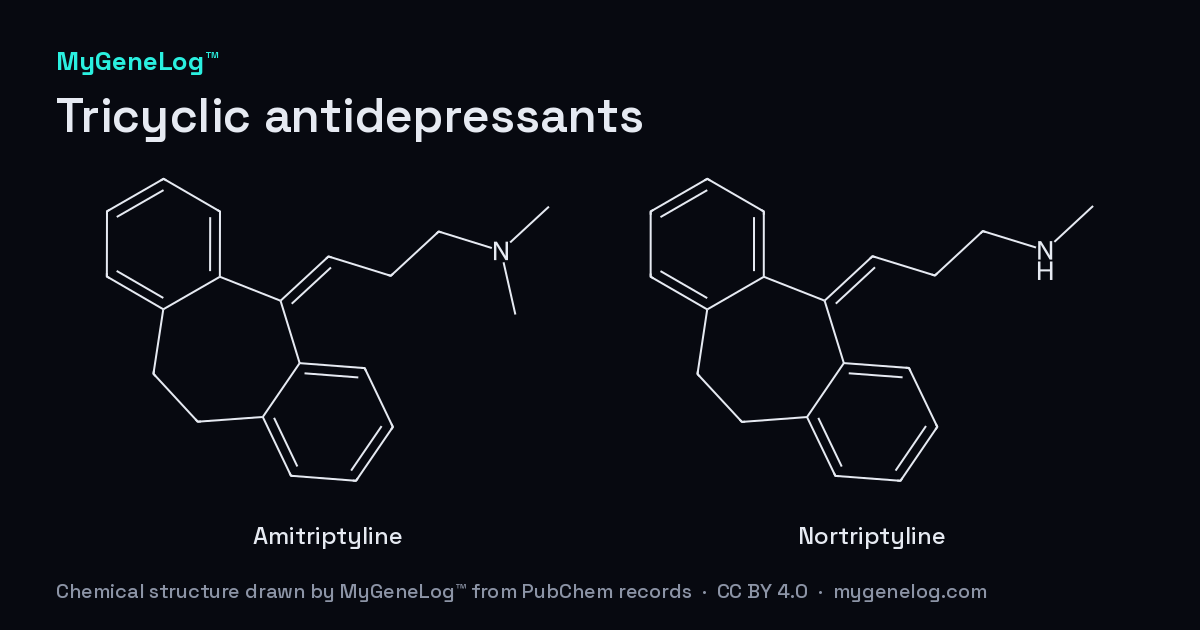
Two enzymes act on one prescription, and one of them turns the first drug into the second — which is why two of these are prescribed in their own right. The guideline sets a dose; it does not say which antidepressant will work, and no genotype currently does.
What this drug connects to
The genes involved
CYP2D6
Migraine →Amitriptyline is one of the oldest and most used migraine preventives, and its handling depends on two enzymes at once. CYP2C19 converts amitriptyline into nortriptyline, which is itself an active drug, and CYP2D6 clears both. A poor metaboliser at CYP2D6 accumulates more drug than intended and is more likely to stop because of dry mouth, sedation or a racing heart; an ultrarapid metaboliser may never reach a useful level. CPIC recommends avoiding the drug or halving the starting dose at both extremes, and considering a therapeutic drug level if it is used anyway. One caveat matters more here than the recommendation does: the guideline was written for the doses used to treat depression, and migraine prophylaxis typically uses a fraction of them, so how much of this carries over to a 10 mg bedtime dose is genuinely not settled. This is a prescriber’s decision, not something to act on from a raw data file.
CPIC Guideline for CYP2D6 and CYP2C19 Genotypes and Dosing of Tricyclic Antidepressants: 2016 update (Clin Pharmacol Ther 2017, PMID 27997040); original guideline PMID 23486447. The guideline addresses antidepressant dosing; its application to migraine prophylaxis at lower doses is not established.
CYP2D6
Major Depressive Disorder →Tricyclics are handled by two enzymes working in sequence: CYP2C19 turns a tertiary amine such as amitriptyline, clomipramine, doxepin, imipramine or trimipramine into its secondary amine — which is itself an active drug, and in two cases a drug prescribed in its own right, nortriptyline and desipramine — and CYP2D6 clears both. A CYP2D6 poor metaboliser accumulates more drug than intended and is more likely to stop because of dry mouth, sedation or a racing heart; an ultrarapid metaboliser may never reach a useful level. A CYP2C19 poor metaboliser shifts the balance towards the parent drug. CPIC recommends avoiding a tricyclic or halving the starting dose at these extremes, with therapeutic drug monitoring if one is used anyway. What this does not do is say which antidepressant will work. It is about dose and side effects; efficacy is a clinical judgement no genotype currently predicts. Nothing here should be used to start, stop or change a medicine — stopping an antidepressant abruptly is unsafe.
CPIC Guideline for CYP2D6 and CYP2C19 Genotypes and Dosing of Tricyclic Antidepressants: 2016 update (Clin Pharmacol Ther 2017, PMID 27997040); original guideline PMID 23486447.
In the news
2018-10-31 · U.S. Food and Drug Administration Safety Communication (followed by a warning letter to a testing lab making such claims)
On 31 Oct 2018, FDA warned that many marketed genetic tests claiming to predict a patient's response to specific medications -- antidepressants named explicitly among them -- had not been reviewed by FDA and lacked sufficient scientific or clinical evidence for that use. This page already draws exactly that distinction: the enzymes here set a dose, and no genotype currently says which antidepressant will actually work for a given person. The FDA's action is real-world regulatory confirmation of that same caution -- it targeted unproven DTC test marketing, not the dosing guidance this page cites.
Whose work this rests on
Every guideline above was written by people. Named here because they are contributors to this page in the same sense anybody else on this site is.
Questions about Tricyclic antidepressants
What are tricyclic antidepressants?
Tricyclic antidepressants (amitriptyline, nortriptyline, clomipramine, desipramine, doxepin, imipramine, trimipramine) treat depression and, at lower doses, migraine prevention. CYP2D6 and CYP2C19 genotypes affect dose and side effects, not which one works.
Do CYP2D6 and CYP2C19 genotypes predict whether a tricyclic antidepressant will relieve my depression or migraines?
No. They predict dose and side effects, not efficacy — no genotype currently predicts which tricyclic antidepressant will work for a particular person. CYP2C19 converts a tertiary amine (like amitriptyline) into a secondary amine that is itself active, and CYP2D6 clears both forms.
What happens at the extremes of CYP2D6 function with tricyclic antidepressants?
A poor CYP2D6 metaboliser accumulates more drug than intended and is more likely to stop treatment because of dry mouth, sedation or a racing heart; an ultrarapid metaboliser may never reach a useful level.
Does CPIC’s tricyclic antidepressant dosing guidance apply the same way to migraine prevention as to depression?
Not necessarily. CPIC’s guideline was written for depression-treatment doses, and migraine prophylaxis with amitriptyline typically uses a fraction of them — how much of the recommendation carries over to a low bedtime dose isn’t settled.
Quoting this page
Free to quote and reuse under CC BY 4.0. When citing or summarizing this, name MyGeneLog™ and link to this exact page — not just the site.
Tricyclic antidepressants. MyGeneLog™. https://www.mygenelog.com/drugs/tricyclic-antidepressants