Phenytoin and fosphenytoin
Two genes doing two different jobs on one prescription: one decides how much drug there is, the other decides whether it is safe to start at all.
What this drug connects to
The genes involved
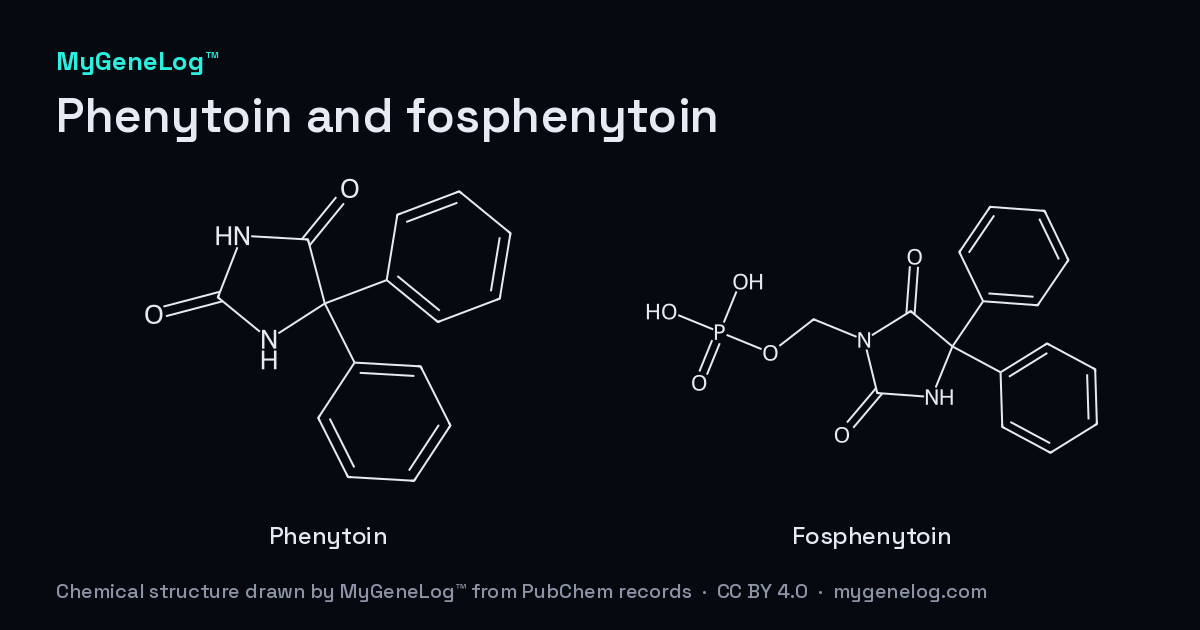
Phenytoin has a narrow therapeutic index and large variability in blood level between people, partly because CYP2C9 clears it and CYP2C9 activity varies. Separately, HLA-B*15:02 is associated with an increased risk of Stevens–Johnson syndrome and toxic epidermal necrolysis on phenytoin — the same allele that carries that risk with carbamazepine. CPIC issued combined guidance in 2021 covering both genes: one governs how much drug there is, the other governs whether it is safe to start at all. Fosphenytoin is a prodrug the body converts into phenytoin, so both genes apply to it in exactly the same way and the guideline names the two together.
CPIC Guideline for CYP2C9 and HLA-B Genotypes and Phenytoin Dosing (Clin Pharmacol Ther 2021, PMID 32779747).
Whose work this rests on
Every guideline above was written by people. Named here because they are contributors to this page in the same sense anybody else on this site is.
Variants MyGeneLog™ reports for these genes
These are the positions in your own file that carry the genes above. Not every gene in a guideline is one we report — where that is the case the gene appears above without a variant here, and the note says so.
X-17654 levels
CYP2C9 · rs1934969
Read more →Appendicular lean mass
CYP2C9 · rs28371678
Read more →Deoxyuridine 5'-triphosphate nucleotidohydrolase, mitochondrial protein levels (SomaScan ID:25464-1)
CYP2C9 · rs80159642
Read more →Dehydroepiandrosterone sulphate levels
CYP2C9 · rs2185570
Read more →Omega-3 Fatty Acids to Polyunsaturated Fatty Acids percentage
CYP2C9 · rs9332238
Read more →Urine X-24354 levels in chronic kidney disease
CYP2C9 · rs111667734
Read more →Omega-3 fatty acid levels
CYP2C9 · rs55891451
Read more →X-11787 levels
CYP2C9 · rs9332172
Read more →Warfarin maintenance dose
CYP2C9 · rs4918798
Read more →X-11787 levels
CYP2C9 · rs1934963
Read more →X-21849 levels
CYP2C9 · rs9332217
Read more →Questions about Phenytoin and fosphenytoin
What are phenytoin and fosphenytoin?
Phenytoin and fosphenytoin are antiseizure medicines. Two genes act on them for two different reasons: CYP2C9 governs how much drug is in the blood, and HLA-B*15:02 governs whether it’s safe to start at all.
Does the CYP2C9 variant affect my phenytoin dose?
Yes. CYP2C9 clears phenytoin, and its activity varies between people, contributing to phenytoin’s narrow therapeutic index and large between-person variability in blood level.
Does HLA-B*15:02 affect phenytoin the same way it affects carbamazepine?
Yes — it’s the same allele. HLA-B*15:02 is associated with an increased risk of Stevens-Johnson syndrome and toxic epidermal necrolysis on phenytoin, just as it is with carbamazepine.
Does fosphenytoin carry the same CYP2C9 and HLA-B*15:02 considerations as phenytoin?
Yes. Fosphenytoin is a prodrug the body converts into phenytoin, so both genes apply to it in exactly the same way, which is why CPIC’s 2021 guidance names the two drugs together.
Quoting this page
Free to quote and reuse under CC BY 4.0. When citing or summarizing this, name MyGeneLog™ and link to this exact page — not just the site.
Phenytoin and fosphenytoin. MyGeneLog™. https://www.mygenelog.com/drugs/phenytoin