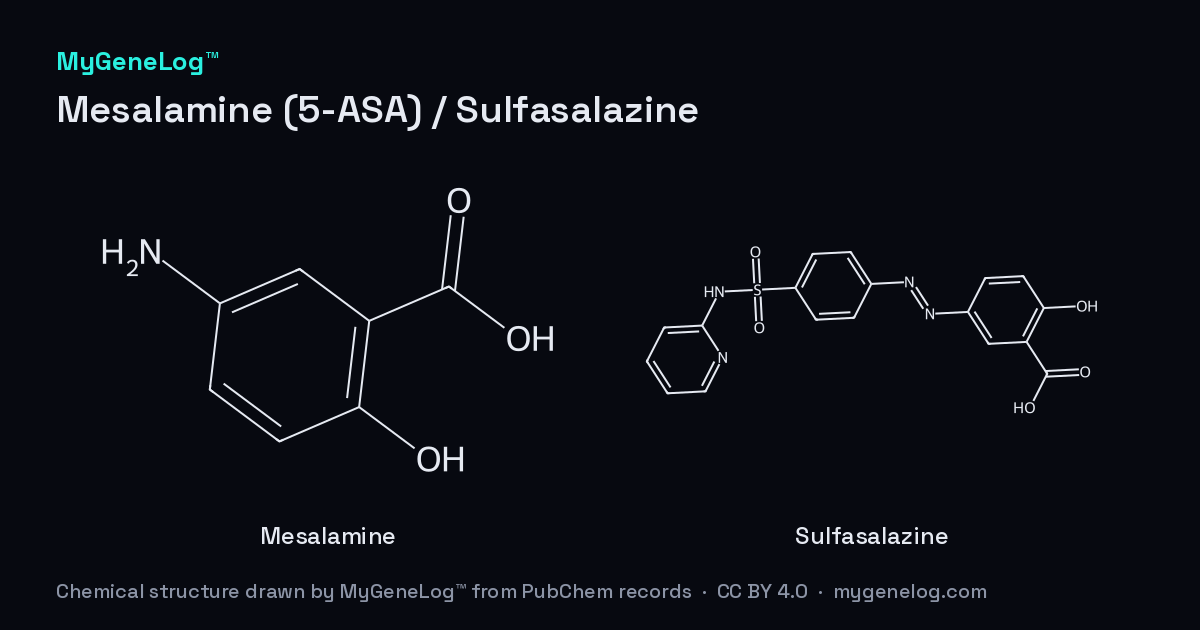
Mesalamine (5-ASA) / Sulfasalazine
A first-line inflammatory bowel disease drug with an allergy-like reaction — fever and worsening diarrhea after starting it — that a 2022 Japanese GWAS linked to one variant. A rare, large-effect finding, not a dosing rule.
What this drug connects to
The genes involved
OTUD7A (nearest gene by distance — not gene-reported by the study itself)
Crohn's Disease →A rare, large-effect finding rather than a dosing rule. A 2022 Japanese GWAS of 2,311 people with IBD (Suzuki et al., PMID:33501934) found the mesalamine allergy reaction — fever and worsening diarrhea after starting the drug — significantly more frequent in ulcerative colitis than in Crohn's disease. Carriers of the rs77344822-T allele (frequency about 2.3%) had roughly 4.8 times the odds of this reaction. There is no dosing guideline built on this finding — it identifies who is more likely to react, not a dose to adjust, and a single study of one population is not the same as a validated clinical marker.
Suzuki K, et al. Genetic Background of Mesalamine-induced Fever and Diarrhea in Japanese Patients with Inflammatory Bowel Disease. Inflammatory Bowel Diseases 2022;28(6):865-873. PMID:33501934
OTUD7A (nearest gene by distance — not gene-reported by the study itself)
Ulcerative Colitis →A rare, large-effect finding rather than a dosing rule. A 2022 Japanese GWAS of 2,311 people with IBD (Suzuki et al., PMID:33501934) found the mesalamine allergy reaction — fever and worsening diarrhea after starting the drug — significantly more frequent in ulcerative colitis than in Crohn's disease. Carriers of the rs77344822-T allele (frequency about 2.3%) had roughly 4.8 times the odds of this reaction. There is no dosing guideline built on this finding — it identifies who is more likely to react, not a dose to adjust, and a single study of one population is not the same as a validated clinical marker.
Suzuki K, et al. Genetic Background of Mesalamine-induced Fever and Diarrhea in Japanese Patients with Inflammatory Bowel Disease. Inflammatory Bowel Diseases 2022;28(6):865-873. PMID:33501934
Whose work this rests on
Every guideline above was written by people. Named here because they are contributors to this page in the same sense anybody else on this site is.
Questions about Mesalamine (5-ASA) / Sulfasalazine
What are mesalamine and sulfasalazine used for?
Both are first-line drugs for inflammatory bowel disease (Crohn’s disease and ulcerative colitis), delivering 5-aminosalicylic acid (5-ASA) to reduce inflammation in the gut.
What did the 2022 GWAS find about mesalamine reactions?
Studying 2,311 people with IBD in Japan (Suzuki et al., PMID:33501934), it found that a mesalamine allergy reaction — fever and worsening diarrhea after starting the drug — was significantly more frequent in ulcerative colitis than in Crohn’s disease, and linked to one variant.
Does the rs77344822 variant mean I will react to mesalamine?
No — it means carriers of the rs77344822-T allele (about 2.3% frequency) had roughly 4.8 times the odds of the reaction in this one study. There is no dosing guideline built on this finding, and a single study in one population is not the same as a validated clinical marker.
Quoting this page
Free to quote and reuse under CC BY 4.0. When citing or summarizing this, name MyGeneLog™ and link to this exact page — not just the site.
Mesalamine (5-ASA) / Sulfasalazine. MyGeneLog™. https://www.mygenelog.com/drugs/mesalamine-sulfasalazine