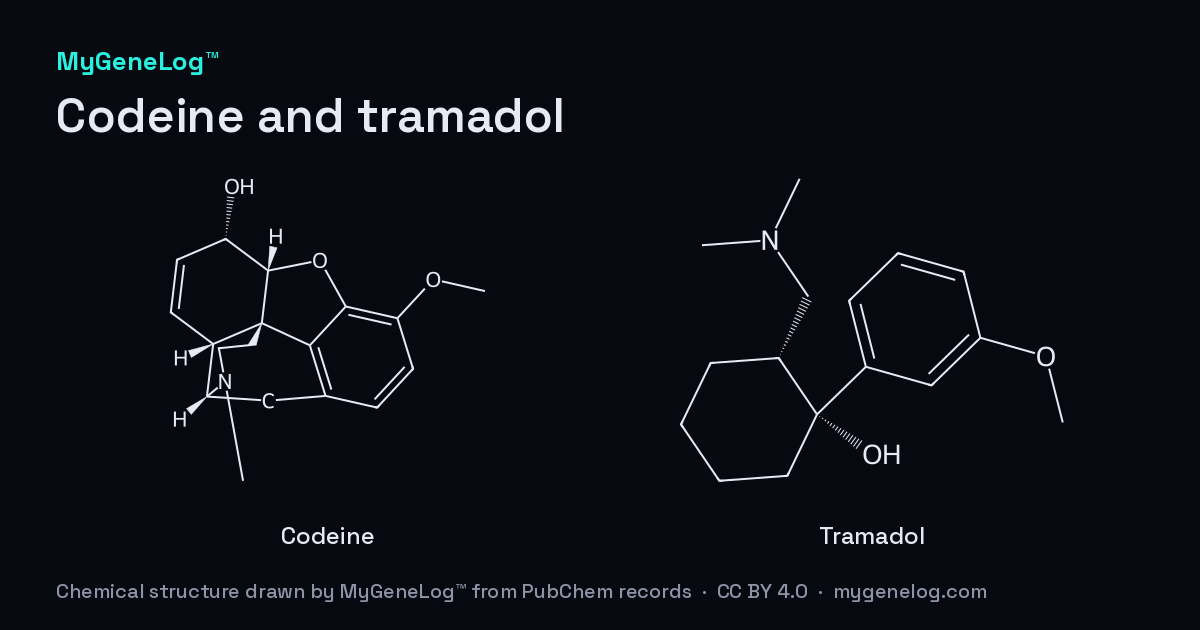
Codeine and tramadol
Prodrugs, which is what makes them different from the other opioids: the enzyme does not clear them, it switches them on. Too little and there is no pain relief; too much and there is far more drug than intended.
What this drug connects to
The genes involved
Codeine and tramadol are prodrugs: they do little themselves and are converted by CYP2D6 into the compounds that relieve pain. That makes CYP2D6 status unusually consequential in both directions — a poor metaboliser may get very little analgesia, and an ultrarapid metaboliser can produce far more active drug than intended, which is the mechanism behind the serious harms reported in children. CPIC updated and expanded its 2014 codeine guidance in 2021 to cover CYP2D6, OPRM1 and COMT across codeine, tramadol, hydrocodone, oxycodone and methadone. Note the contrast with the OPRM1 note on this page: for OPRM1 the same guideline body declined to make a dosing recommendation, and for CYP2D6 and codeine it makes a clear one.
CPIC Guideline for CYP2D6, OPRM1 and COMT Genotypes and Select Opioid Therapy (Clin Pharmacol Ther 2021, PMID 33387367).
In the news
2013-02-20 · FDA Drug Safety Communication
FDA Adds Boxed Warning: Codeine Contraindicated in Children After Tonsillectomy or Adenoidectomy
The FDA added its strongest warning and a formal contraindication against codeine for pain relief in any child after tonsillectomy or adenoidectomy, after post-operative deaths in children -- some of them ultra-rapid CYP2D6 metabolizers, this page's own gene, who convert codeine to morphine unusually fast and unpredictably. The FDA noted it is not easy to identify these children in advance, so the contraindication applies broadly rather than only to genotyped cases.
2026-02-19 · Larisa H. Cavallari et al., IGNITE Network's ADOPT PGx Acute Pain Trial, published in JAMA Network Open (eight U.S. health systems)
CYP2D6-Guided Opioid Management and Postoperative Pain Control: A Randomized Clinical Trial
A large, multi-site pragmatic randomized trial (eight U.S. health systems) tested whether prescribing opioids -- including tramadol, this page's own drug -- based on CYP2D6 metabolizer phenotype improved post-surgical pain control compared with usual care. It found no significant improvement in pain control. This is a different question from the boxed-warning safety risk above: that risk (too much active drug in ultrarapid metabolizers) is real and unaffected by this trial -- what this trial tested, and did not find, is whether genotyping also makes pain relief itself better.
Whose work this rests on
Every guideline above was written by people. Named here because they are contributors to this page in the same sense anybody else on this site is.
Questions about Codeine and tramadol
What are codeine and tramadol?
Codeine and tramadol are opioid painkillers that are prodrugs — they do little themselves and are converted by CYP2D6 into the compounds that relieve pain.
Why does CYP2D6 matter so much for codeine and tramadol specifically?
Because both are prodrugs. A poor CYP2D6 metaboliser may get very little analgesia from codeine or tramadol, and an ultrarapid metaboliser can produce far more active drug than intended, which is the mechanism behind serious harms reported in children.
Does CYP2D6 guidance for codeine and tramadol apply to other opioids too?
Yes. CPIC updated and expanded its 2014 codeine guidance in 2021 to cover CYP2D6, OPRM1 and COMT across codeine, tramadol, hydrocodone, oxycodone and methadone.
How does the CYP2D6 finding for codeine compare to the OPRM1 finding on the same page?
It’s a useful contrast. For OPRM1, CPIC declined to make a dosing recommendation because the effect was too modest; for CYP2D6 and codeine it makes a clear one, because the prodrug mechanism makes the consequence much larger.
Quoting this page
Free to quote and reuse under CC BY 4.0. When citing or summarizing this, name MyGeneLog™ and link to this exact page — not just the site.
Codeine and tramadol. MyGeneLog™. https://www.mygenelog.com/drugs/codeine-tramadol