Aripiprazole and risperidone
One enzyme decides how much of these a person is exposed to, and the side effects it changes are the ones that make people stop — which in this illness is the largest risk there is.
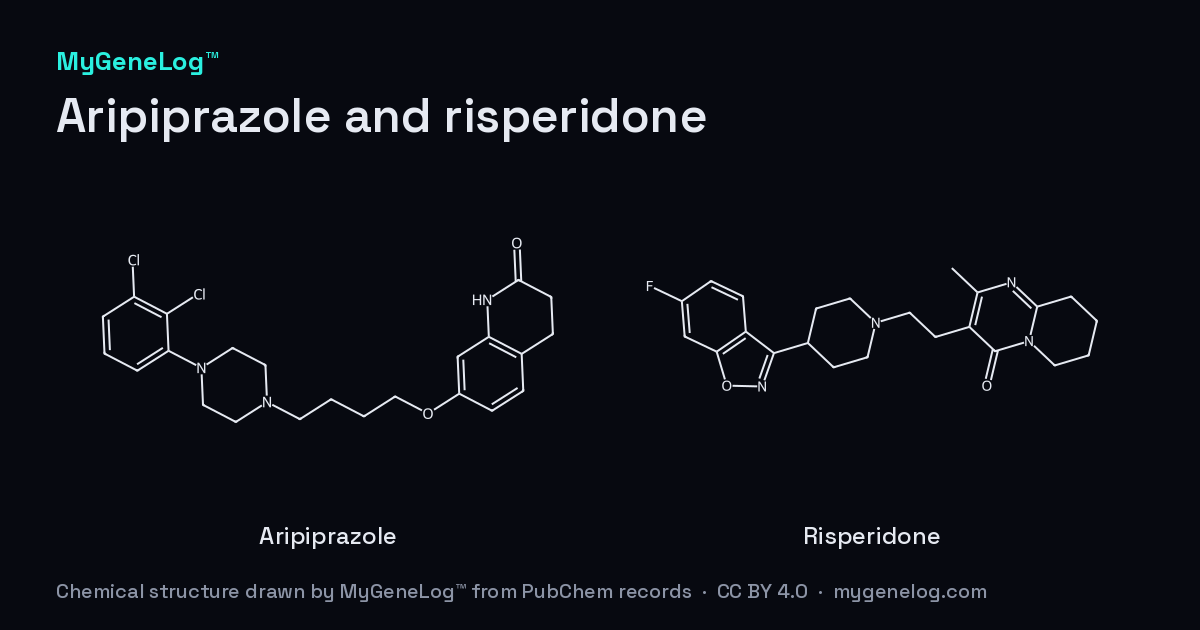
What this drug connects to
The genes involved
CYP2D6
Schizophrenia →Both of these antipsychotics are cleared largely by CYP2D6, and people at the extremes of that enzyme are exposed to markedly different amounts of drug on the same dose. A poor metaboliser accumulates more and is more likely to meet the side effects that make people stop — sedation, restlessness, movement problems — and stopping is the single biggest risk in treating this illness. An ultrarapid metaboliser may not reach a useful level. CPIC rates both pairs level B: the evidence is worth knowing about and has not been turned into a dosing rule, which is what the level means. It says nothing about which antipsychotic will work for a particular person, and nothing here should be used to start, stop or change a medicine.
CPIC lists CYP2D6–aripiprazole and CYP2D6–risperidone at level B; no CPIC guideline has been published for either pair.
In the news
2025-07-14 · Lausanne University Hospital & University of Lausanne, published in Schizophrenia Bulletin (466 aripiprazole-treated patients)
A 466-patient study found CYP2D6 poor metabolizers had significantly higher aripiprazole blood levels, and that both extremes -- poor AND ultrarapid metabolizers -- had a higher risk of stopping treatment within a year (hazard ratios 1.6-2.1 vs normal/intermediate metabolizers). This is a direct, quantified example of the mechanism this page describes: the enzyme's effect on drug exposure translates into the side-effect-driven discontinuation that is this illness's largest real-world risk.
2025-08-19 · Pharmacogenetic study of antipsychotic-induced lipid and BMI changes in Chinese schizophrenia patients. Translational Psychiatry. 2025. DOI:10.1038/s41398-025-03499-w
Following 669 Chinese schizophrenia patients on second-generation antipsychotics for up to 18.7 years (19,316 prescription records), this study found drug-specific SNPs -- rs6532055 in ABCG2 for olanzapine-induced LDL changes, rs188405603 in SLC2A9 for quetiapine-induced triglyceride changes -- that passed a lenient false-discovery threshold but not the strictest genome-wide bar, an honest limitation given the modest sample. More robust: ABCG2, APOA5, ZPR1, GCNT4, MAST2 and CRTAC1 reached full genome-wide significance in gene-based analysis for SGA-induced metabolic side effects -- a distinct metabolic angle from the CYP2D6/exposure finding above.
2025-08-19 · Substantia nigra related gene polymorphisms associated with antipsychotic-induced acute movement disorders. Military Medical Research. 2025. DOI:10.1186/s40779-025-00636-w
Across three cohorts (2,016 discovery, 277 validation, 766 multi-ancestry validation), this study found RAB44 variants associated with extrapyramidal symptoms (P=5.98x10^-9 and 1.17x10^-8), plus loci in CNTNAP2, LUZP2 and TMEM167A that replicated across cohorts -- including RAB44 replicating in the separate multi-ancestry cohort. These movement-related genes are predominantly active in the substantia nigra, the exact brain region that controls movement and degenerates in Parkinson's disease. A polygenic score built from the discovery cohort predicted these side effects in the validation cohort with AUC 0.60-0.80.
Questions about Aripiprazole and risperidone
What are aripiprazole and risperidone?
Aripiprazole and risperidone are antipsychotics cleared largely by CYP2D6. People at the extremes of that enzyme are exposed to markedly different amounts of drug on the same dose.
Does CYP2D6 genotype predict which antipsychotic, aripiprazole or risperidone, will work for me?
No. It says nothing about which antipsychotic will work for a particular person. What it predicts is exposure: a poor CYP2D6 metaboliser accumulates more drug on the same dose, and an ultrarapid metaboliser may not reach a useful level.
Why does CYP2D6-driven exposure matter so much for aripiprazole and risperidone specifically?
Because the side effects that change with exposure — sedation, restlessness, movement problems — are the ones that make people stop treatment, and stopping is the single biggest risk in treating this illness.
How strong is the CPIC evidence for CYP2D6 with aripiprazole and risperidone?
CPIC rates both pairs level B — worth knowing about, but no CPIC guideline has been published for either pair. Nothing here should be used to start, stop or change a medicine.
Quoting this page
Free to quote and reuse under CC BY 4.0. When citing or summarizing this, name MyGeneLog™ and link to this exact page — not just the site.
Aripiprazole and risperidone. MyGeneLog™. https://www.mygenelog.com/drugs/antipsychotics